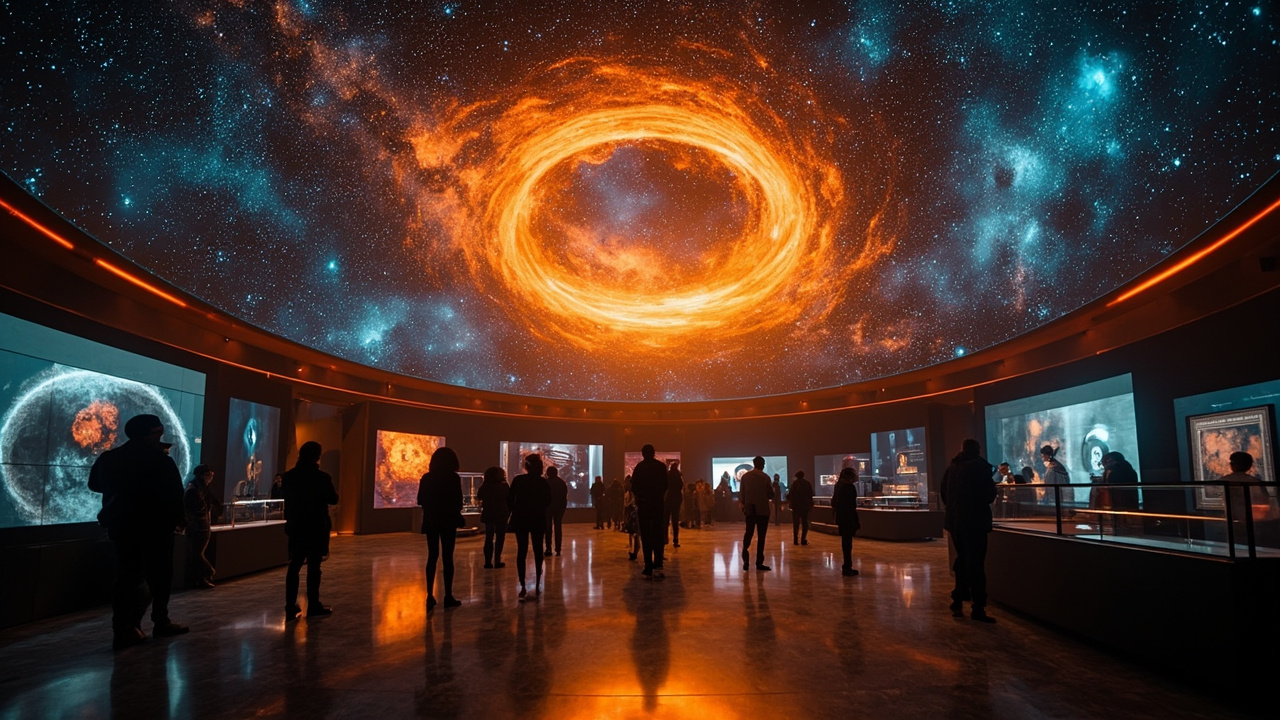
A new window into humanity's quest to understand the cosmos opened today at the Smithsonian's National Air and Space Museum in Washington, D.C. The "U.S. National Science Foundation Discovering Our Universe" gallery, unveiled on the museum's 50th anniversary, brings together the most important artifacts from a half-century of astronomical breakthroughs.
The gallery takes visitors on a journey through the evolution of cosmic discovery — from the first image of a black hole captured by the Event Horizon Telescope to the detection of gravitational waves by LIGO, and from Vera Rubin's original spectrograph that provided the first evidence for dark matter to neutrino detectors that have captured particles from beyond our galaxy.
"Humanity has wondered at the cosmos throughout our history," said Brian Stone, performing the duties of the NSF director. "NSF is thrilled to partner with the Smithsonian to showcase how basic research investments spark our imagination, inspire generations, and enable incredible scientific breakthroughs."
Designed for accessibility and education, the gallery features a hands-on Discovery Cart, touchable exhibits, and audio descriptions. It's also built for remote learning — museum educators can broadcast lessons to classrooms anywhere in the world.
The gallery is one of five new exhibitions opening as the museum celebrates its 50th anniversary, timed to coincide with the nation's 250th birthday celebrations.
Admission is free, but timed-entry passes are required.