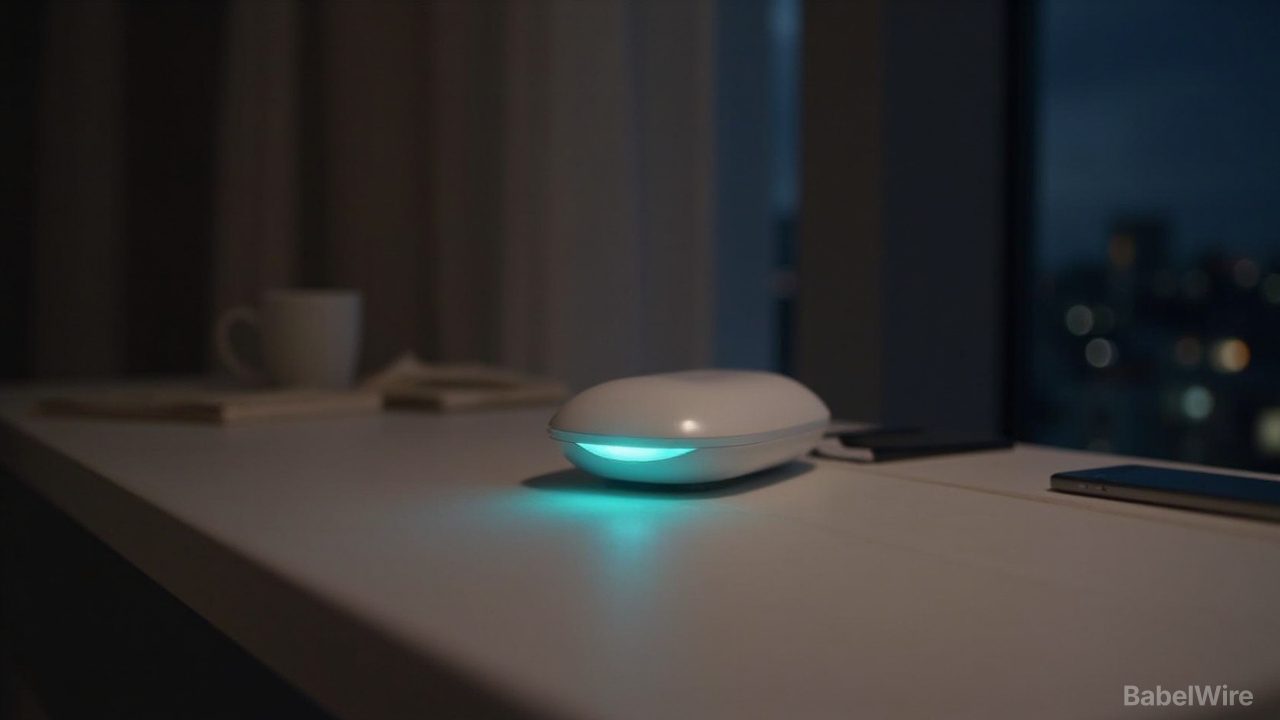
Nothing will unveil its first "AI-native" product in December. CEO Carl Pei announced it on X in three sentences: it ships next month, it has "no new screen", and it "couldn't have been an app." He gave no name, no price and no feature list. It is a tool, he wrote, "but one built with the personality and care that a Nothing product is known for."
The more interesting part of the announcement is the argument behind it. The industry is chasing the next iPhone moment too early, Pei says. "The iPhone was the culmination of thirty years of development that started with pagers on doctors' belts and ended with a supercomputer in every pocket." AI, by contrast, is "only at the beginning of its development and is currently stuck in a chat window. The search for the 'iPhone of AI' is a dead end today."
Where he expects product-market fit to appear first: productivity, the tools people rely on to get concrete tasks done. And that is where he names the real obstacle, which is not intelligence but context. People connect inboxes and calendars, screenshot Slack threads, explain the background — and "half the work of using AI is pasting the context into the text box."
The context that matters most never reaches the model at all. "Think about the last time someone said something worth capturing: an idea over coffee, a passing remark that set your whole week in motion." By the time you have taken the phone out of your pocket, the moment is gone. "That is the gap," Pei writes. Context is not found in a chat window; it lives in the tools you use every day and carry with you.
That diagnosis leads more or less directly to a device that listens. "No new screen" points to a companion to the smartphone rather than a replacement, and "couldn't have been an app" is a jab at precisely the category Nothing is now entering. Humane's AI Pin failed outright; the Rabbit R1 ended up as an Android agent. The field is crowded anyway: the Plaud Note dictaphone, the open-source pendant Omi, which ships every word to the cloud, the Looki L1, which also records video, and Amazon's Bee Frontier and Bee Eclipse, launched for the US in October. Apple has announced something like Audio Intelligence for its newer watches.
So Nothing inherits the category's central problem, and it is not a hardware problem. The value of a device that is always listening depends entirely on whether you trust it. Pei's essay does not answer the questions that decide that: what is processed where, how long it is kept, who can reach it, and what happens if the company changes its pricing or shuts the cloud off. For a gadget that harvests context from conversations, privacy is not a feature among others — it is the product.
Nothing does bring real advantages. It has a brand that ships hardware at volume, a distribution base, an AI button already on its current phones and an AI-native operating system in development. It raised $200 million last year. That is more than Humane ever had, and Pei has the advantage of being able to study his predecessors' failure rather than repeat it.
What the device actually does remains open. A capture device for thoughts would be the literal implementation of Pei's essay — and a market where a phone with a voice-memo app already plays for free. A device that executes tasks rather than transcribing them would be considerably harder to build and to sell. December will show which version Nothing puts on stage.
What to watch: whether it only captures or also acts; what runs on-device and what goes to the cloud; how long data is retained and whether it can be deleted; whether a subscription is required; and whether Pei demonstrates a completed task instead of a demo.