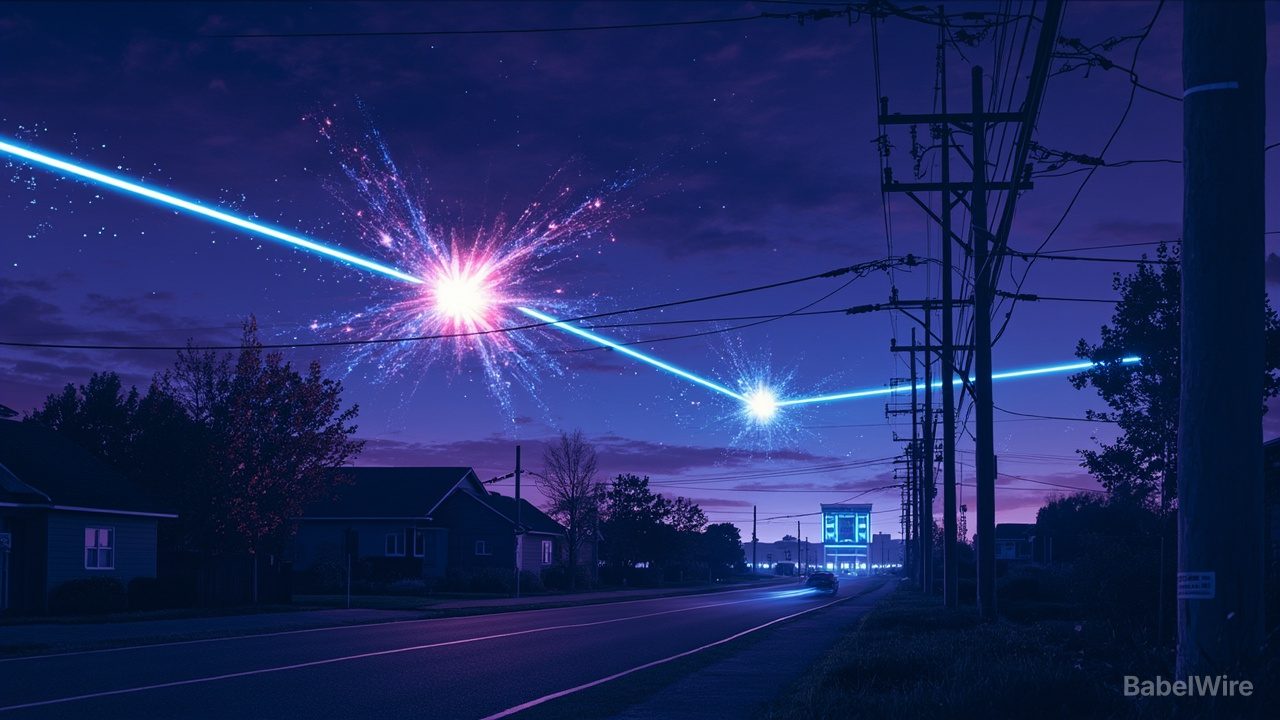
In a stress test for the future 'quantum internet', researchers from NIST, the Joint Quantum Institute (NIST–University of Maryland) and the New York company Qunnect sent entangled photons through 62 kilometers (38.5 miles) of commercial fiber — much of it strung on utility poles above the Maryland suburbs. The fiber sways in the wind, expands and contracts with temperature, and hosts birds; physicist Oliver Slattery calls it 'about as bad a connection as you can possibly have' for delicate quantum states.
Entanglement, the phenomenon Einstein dubbed 'spooky action at a distance', means two photons share a single quantum state: measure one and the other is determined, no matter the distance. Quantum networks built on it could link telescopes for ultra-sharp astronomy, spread entangled sensors to detect earthquakes, connect quantum computers, and enable unhackable communications. But entangled states are fragile — and on real-world fibers, polarization twists threaten to destroy them.
The team's solution: Qunnect's polarization-stabilization devices send reference light through the same fiber, measure how the polarization was scrambled, and apply the exact inverse to the quantum photons in real time. Over 24 hours, entangled photons were delivered 92.8% of the time (only 7.2% spent correcting polarization), at a rate of 1,500 entangled photons per second — and statistical tests confirmed the photons at each end were genuinely entangled.
The experiment, reported in the Journal of Optical Communications and Networking (published online July 15), doesn't break distance records — a European group distributed entanglement over 248 km of underground fiber in 2022. Its significance is the environment: mostly above-ground fiber exposed to everything real-world networks will face. 'We put this to an extreme test in an environment that's really noisy. Amazingly, it turned out it still worked,' says lead author Yicheng Shi. 'It's a demonstration that quantum networking protocols can work in real-world environments.'