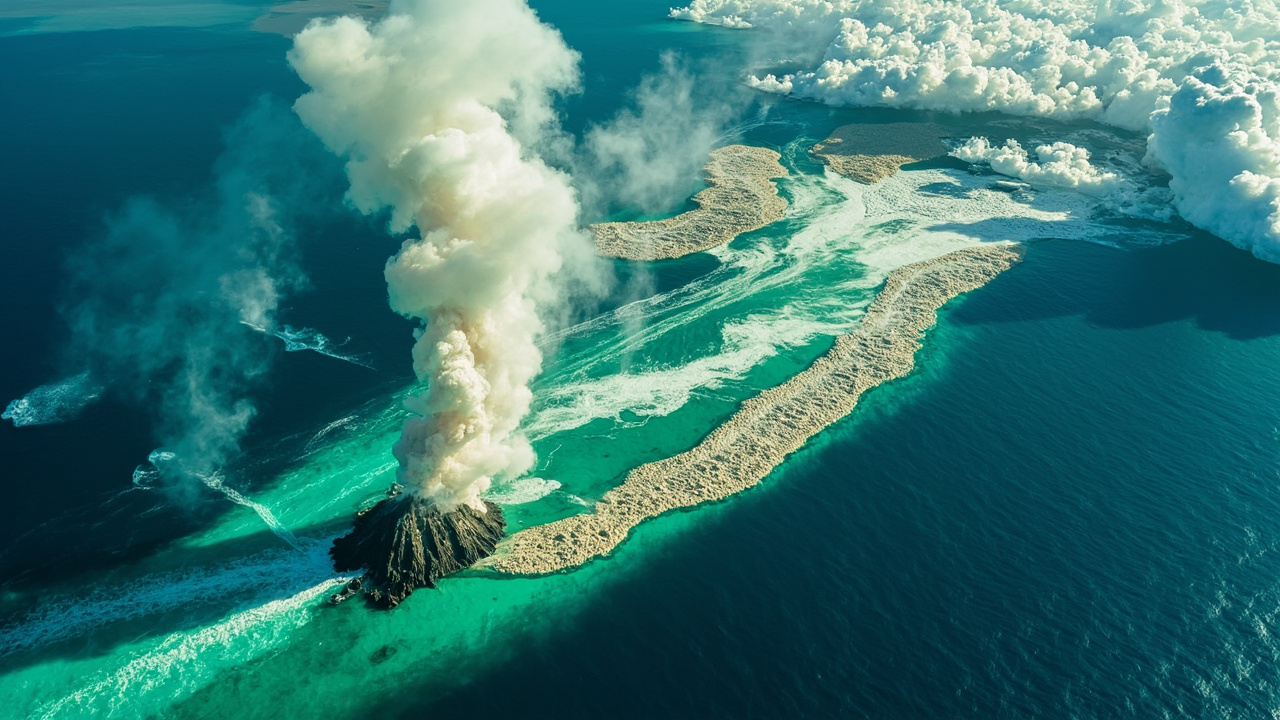
A rare submarine volcanic eruption in the Bismarck Sea, north of Papua New Guinea, is captivating scientists as NASA satellites track its evolution from space — potentially witnessing the birth of Earth's newest island.
The eruption began on May 8, 2026, detected first by a small cluster of earthquakes. Soon after, NASA's Aqua and Terra satellites captured optical images of white, steam-rich volcanic plumes rising into the atmosphere above the Central Bismarck Sea. The event is believed to be taking place along Titan Ridge, about 16 kilometers southeast of a submarine eruption recorded in 1972.
"The good news is that there are huge opportunities to explore and learn using both government and commercial satellite platforms already in orbit," said Jim Garvin, chief scientist at NASA's Goddard Space Flight Center.
A rare natural laboratory
What makes this eruption particularly remarkable is its location in one of the most poorly mapped regions of Earth's seafloor. Oceanographers often note that the surfaces of the Moon and Mars are mapped more precisely than much of the deep seafloor on Earth. The Bismarck Sea is a geologically complex basin with faults, volcanic structures, rifts, and active subduction zones at depths that are difficult to map in detail.
Multiple satellites are now monitoring the event. The European Space Agency's Sentinel 2 and NASA/USGS Landsat 9 captured detailed imagery showing activity close to the ocean surface. On May 12, the VIIRS instrument on the Suomi NPP satellite detected heat anomalies spread across roughly seven square kilometers — evidence of hot material near the surface.
"There must be a lot of hot material near the surface to generate so many thermal anomalies," said Simon Carn, a volcanologist at Michigan Tech. "This suggests a fairly shallow eruption vent."
**Will a new island form?**
Optical satellite images show vigorous activity in shallow water, with areas of discolored water and many steam and ash vents spread across the surface. Broad pumice rafts — floating volcanic rocks — have formed long streaks in surface currents, another sign that magma is reaching shallow depths.
"We're now eagerly waiting to see if a new island is about to be born — something that we've only rarely been able to observe with satellites as it happens," Garvin said.
If new land emerges, volcanologists will monitor how it evolves. It might grow into a tuff cone with a vent crater that lasts for some time, or it could quickly collapse and wear away. The eruption could also become more explosive if seawater reaches the shallow magma chamber.
Different from Hunga Tonga
So far, this eruption has been far less explosive than recent submarine eruptions such as Hunga Tonga-Hunga Ha'apai in 2022. Carn notes that spreading centers like Titan Ridge are associated with less explosive activity, unlike the subduction zones that produce the most violent eruptions.
It remains unclear how long the eruption will continue. The 1972 eruption in the same general region lasted only four days, while another submarine eruption about 100 kilometers away continued for nearly four years.
A window into planetary formation
If a lasting island forms, Garvin sees an opportunity for researchers — or "island-nauts" — to study how a young island responds to plant and animal colonization, rainfall, chemical weathering, and other forms of erosion. "This new eruption could present an even better opportunity for 'island-naut' exploration as we prepare to return to the Moon with women and men via Artemis IV," he said.
The event provides a rare window into the geological processes that build planetary surfaces — not just on Earth, but on other worlds as well.