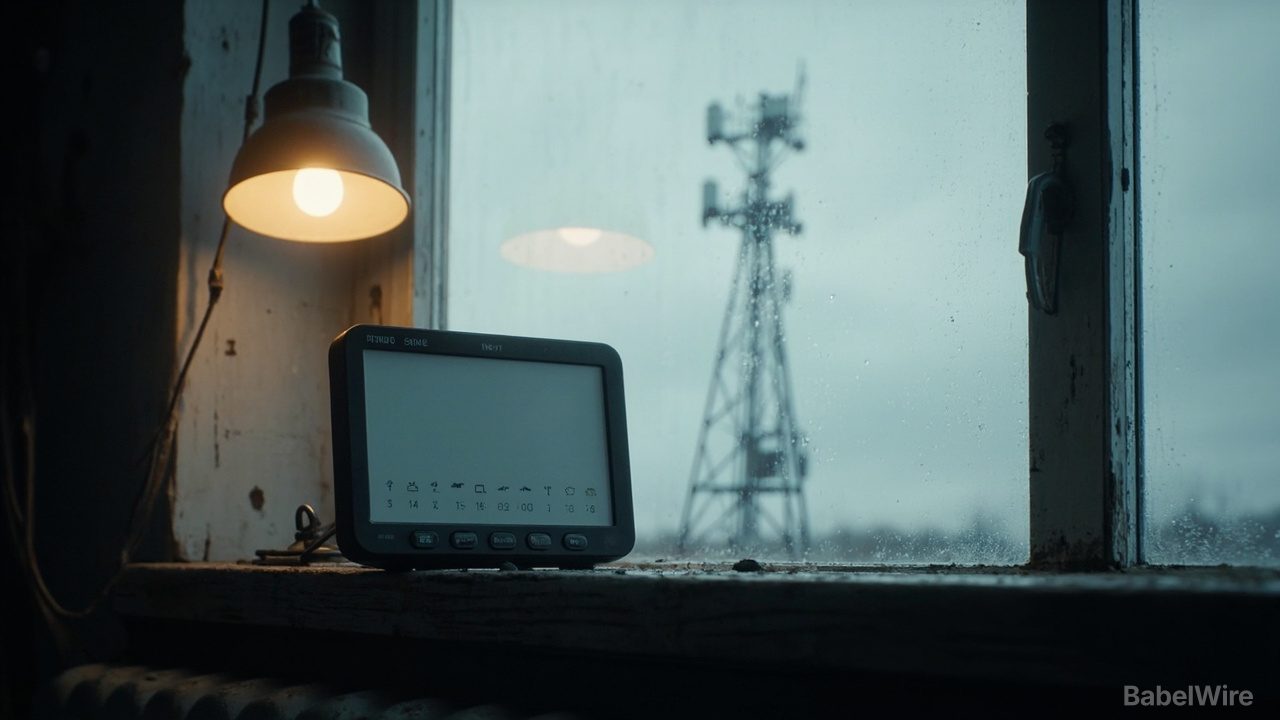
At 77.5 kilohertz, the longwave transmitter at Mainflingen has been doing its job without interruption. Every minute it broadcasts the German legal time, one bit per second, and every radio-controlled clock in western Europe wakes up, corrects itself and goes back to sleep. What stopped on 30 June 2026, at around 18:00 CEST, is the other thing riding on that signal: the weather forecast.
The forecasts belong to Meteotime, a service operated out of Wutha-Farnroda that has been licensed to place content in the DCF77 data stream for about twenty years. Stations from Hama, Bresser and TFA Dostmann decode those bits and display symbols, precipitation probability, sunrise and sunset, temperatures and weather warnings. Since the end of June they have displayed none of it.
The interesting part is why it is still broken four months later. A technician at the operator told heise online this week that the outage began with failed control technology, but that the conversation has moved on. Sales have collapsed. Talks are now underway about how to finance the service at all, and the outcome is unknown.
Scale is the reason this matters beyond a niche of gadget owners. Meteotime says roughly 600,000 to 700,000 devices capable of receiving its data were built, and that several thousand in Germany are probably still in daily use. Those devices cannot be patched. The failure is inside a broadcast protocol, not a firmware bug, so nothing short of a replacement unit fixes it — and none of the affected hardware can be moved to an internet feed by its owner.
The vendors are improvising. Hama has published a support page offering a free exchange for its "Meteotime Wettervorhersage-Center", regardless of where the station was bought, against an internet-connected alternative that is not fully feature-equivalent. TFA Dostmann has its own page, points out that the devices are not defective — temperature and humidity still work — and uses the occasion to argue that the episode shows how important independent, internet-based weather services are.
There is a quiet lesson in the failure mode. DCF77 is one of the most reliable pieces of infrastructure in Europe precisely because it is stupid: a carrier, a modulation, a clock. It was never designed to carry a commercial product's payload for two decades with no successor, no notice period and no path for the hardware to fall back to something else. Meteotime did have an outage before, in August 2024, and recovered within days. This one has no published recovery date at all.