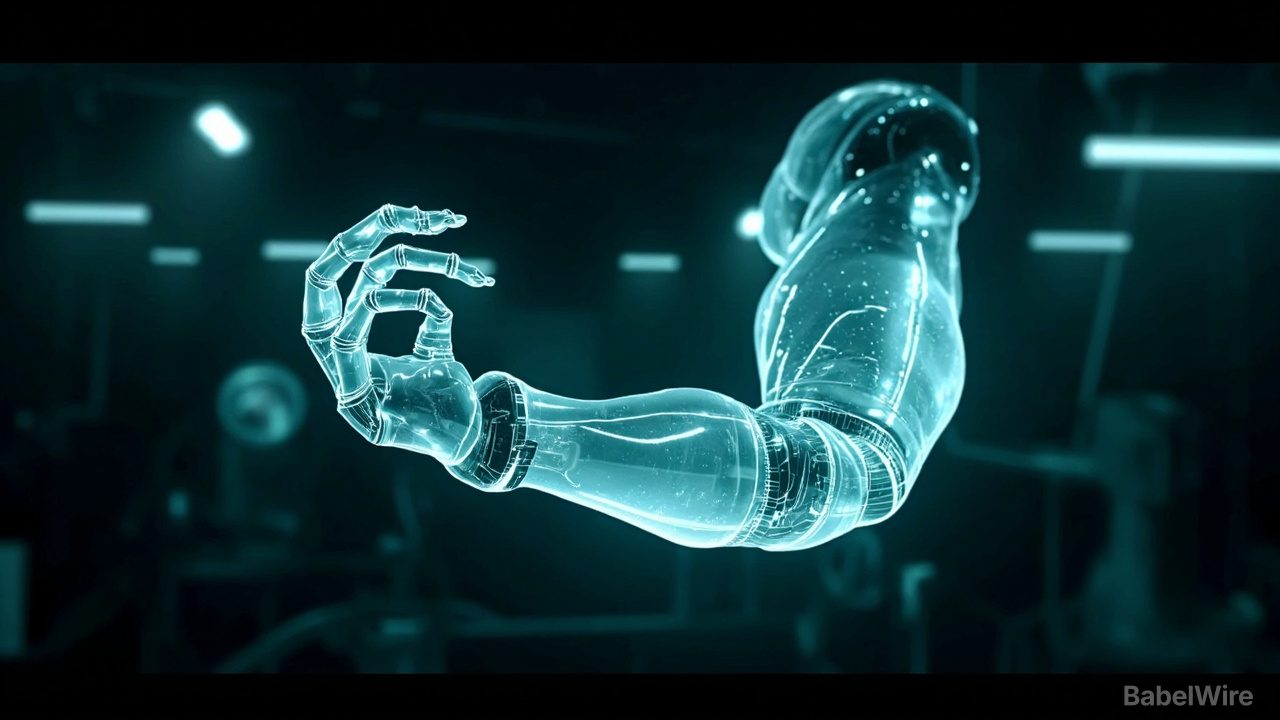
Soft robots bend, stretch and grip constantly, and tracking exactly where and how hard they deform is awkward: you normally need strain gauges, cameras or wiring that limits how soft the thing can stay. Researchers now report a way to make those movements visible without adding any power at all.
The trick is mechanoluminescence — certain materials emit light when they are mechanically stressed. Coat or embed such a material in a soft robot's body and every bend, squeeze and twist shows up as a faint glow exactly where the deformation happens. The light is generated by the deformation itself, so the readout needs no battery, no electronics and no tether.
That makes it useful in exactly the places soft robots are most interesting: medical devices inside the body, grippers handling delicate objects, and structures you would rather not open up to inspect. It also flips a quantitative problem into a qualitative one at a glance — a researcher or clinician can see the strain field rather than reconstruct it from a sensor trace.
The trade-off is resolution and calibration: a glow tells you where the stress sits long before it tells you how much. The materials and demonstrations are described in Heise's report.