A team led by Alexander Berne and publishing in Nature has discovered that Mars southern interior is between 200 and 400 degrees Celsius hotter than the north — and partially molten. The finding, made using a technique called tidal tomography, reshapes our understanding of the Red Planet internal structure and the conditions that may once have supported life.
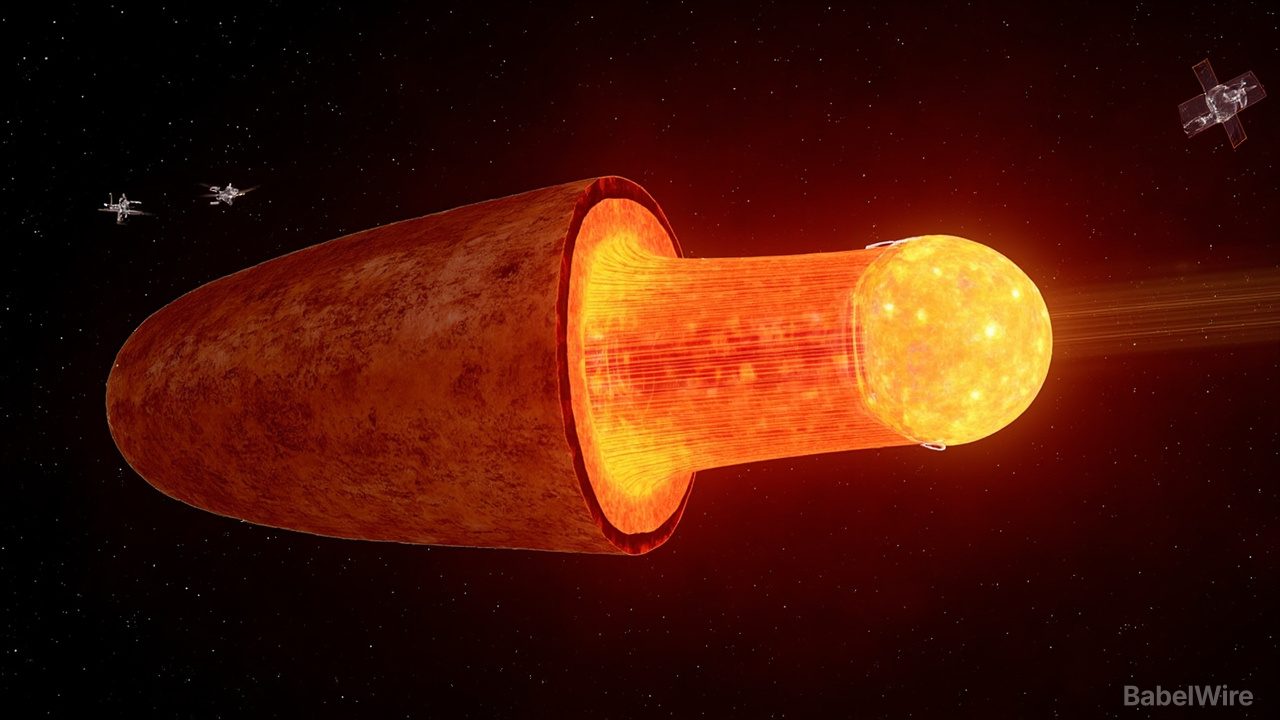
The research leveraged gravitational data collected over decades by three orbiters — Mars Global Surveyor, Mars Odyssey, and Mars Reconnaissance Orbiter. By tracking tiny changes in each spacecraft velocity, the team reconstructed the gravitational field around Mars. The Sun gravitational pull on Mars shifts with the seasons because the planet follows a slightly elliptical orbit on a tilted axis, and tidal tomography exploits those changes to build a three-dimensional model of the interior.
The discovery provides a single unifying explanation for several long-standing Martian puzzles. The hotter southern mantle could explain the magnetic anomalies locked into iron-bearing minerals in the south — a warmer interior could have sustained a magnetic field strong enough to imprint the north-south differences still detectable today. It also aligns with an observation from NASA InSight lander, which found that seismic waves dissipate more quickly in the south, exactly what would be expected if that region were warmer.
What created the thermal divide remains an open question. Leading hypotheses include a giant impact that released heat across the northern hemisphere, past spontaneous convection within the southern mantle, or thick geological structures trapping heat.
The technique itself has broader implications. As Berne notes, planetary interiors are usually assumed to be roughly spherically symmetric — but that assumption need not hold. With enough gravity data, the true three-dimensional structure emerges, providing a blueprint for designing future missions to Mars.
Publication: Alexander Berne et al., Tidal tomography reveals a thermal anomaly beneath Mars crustal dichotomy, Nature (2026). DOI: 10.1038/s41586-026-10893-x