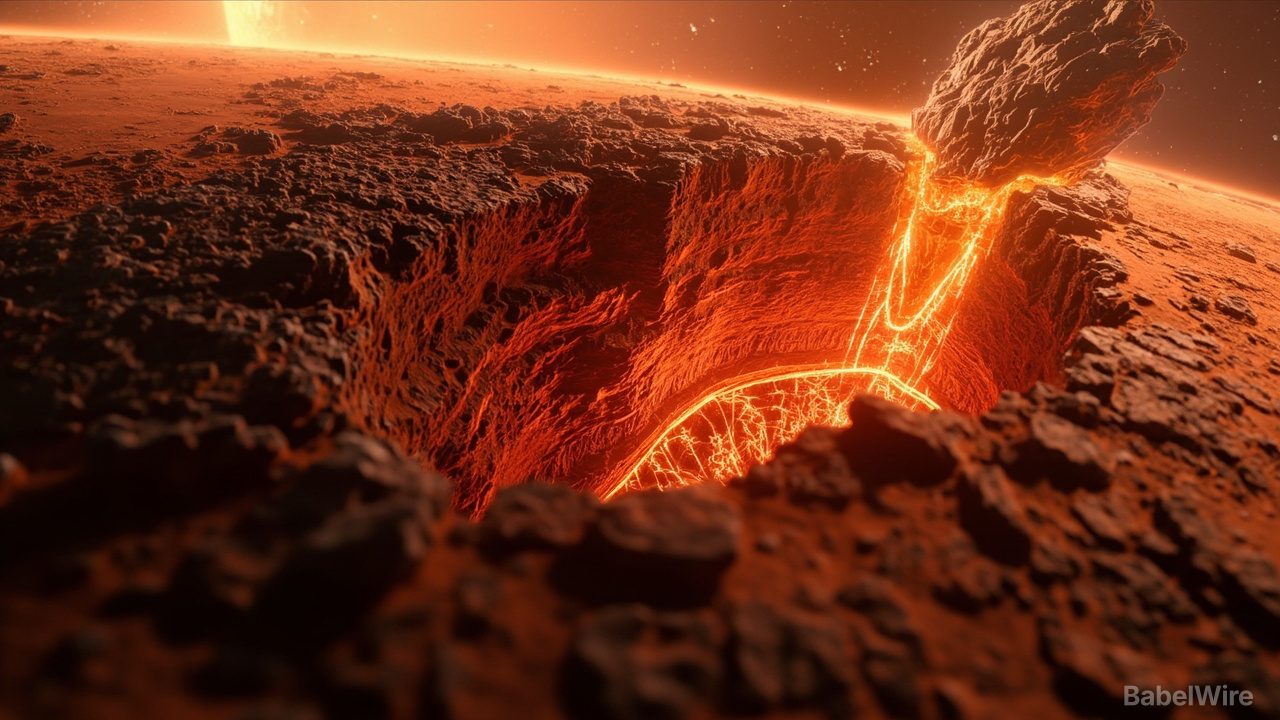
Researchers at the University of Oxford have found evidence that Mars may once have contained enormous Earth-like magmatic systems deep below its surface, even though the planet does not have the plate tectonics that scientists have long associated with this level of geological complexity.
The study, published in Nature Astronomy, analyzed seismic data collected by NASA's InSight mission, focusing on waves generated by meteoroid impacts and marsquakes. Scientists identified an unexplained boundary roughly 24 kilometers beneath the Martian surface, which they now believe represents evidence of a vast, interconnected magmatic system.
The analysis showed that rocks beneath the 24 km boundary were best explained by 'ultramafic' material rich in iron and magnesium, while above the boundary, the seismic properties were more consistent with 'mafic' rocks containing a higher proportion of silica.
Lead author Dr. Tobermory Mackay-Champion said: 'We've traditionally assumed that volcanism on Mars was relatively simple compared to that on Earth. But this discovery suggests Mars could sustain large, long-lived systems where molten rock evolved and reprocessed itself throughout the entire crust.'
The buried layer may be enormous in scale, potentially extending for hundreds or even thousands of kilometers across Mars' northern hemisphere. This suggests ancient Mars was not dominated only by simple, isolated volcanoes, but may once have contained huge, connected magmatic systems spanning large portions of its crust.
The findings have broader implications for understanding how rocky planets become habitable. Professor Jon Wade noted: 'One of the big questions in planetary science is whether Earth is unique. If Mars could develop this kind of complex crust without plate tectonics, then maybe the conditions needed for habitability can emerge on more planets than we realized.'
Sources
- sciencedaily.comDeep beneath Mars, scientists find a vast hidden magma system | ScienceDaily
- universetoday.comMars May Have Vast Magma Systems Beneath Its Surface | Universe Today
- ox.ac.ukNew evidence suggests vast hidden magma systems inside Mars | Oxford University
- nautil.usThe New Seismic Discovery Beneath the Surface of Mars | Nautilus