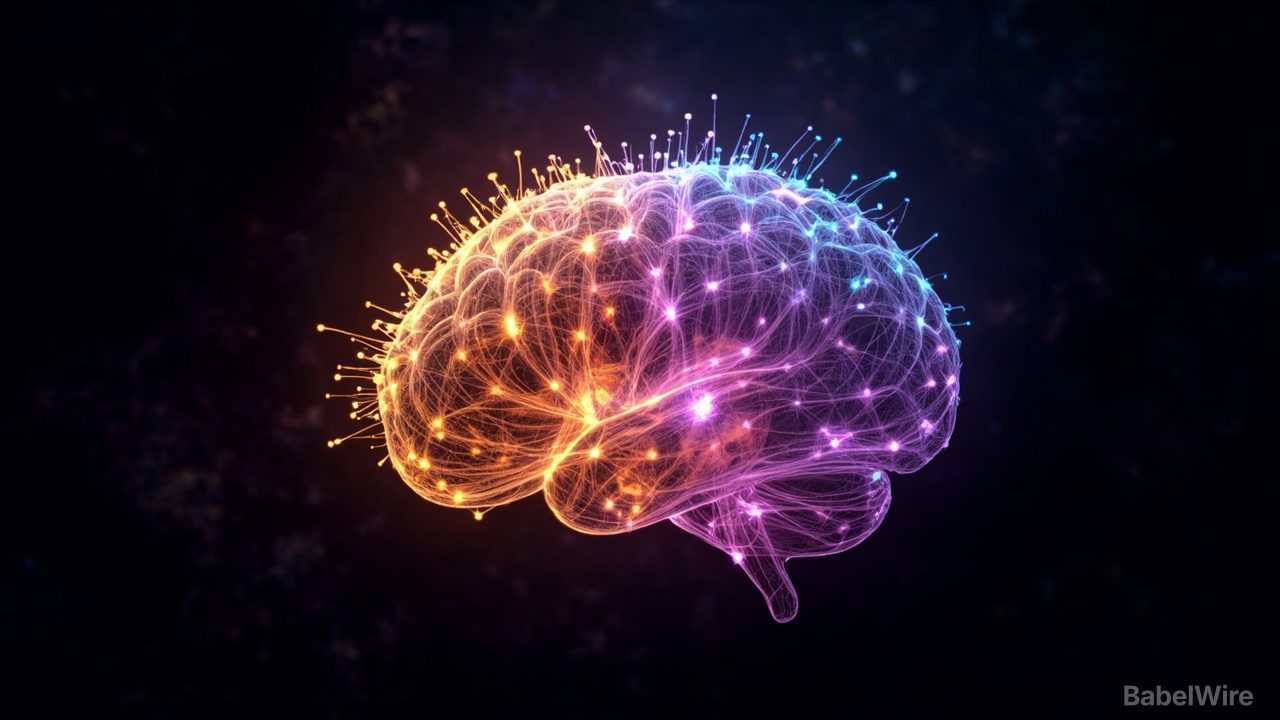
Researchers have completed a map of every neuron in the brain of a male fruit fly — the second full connectome of a Drosophila brain, joining a map of a female fly published earlier this year. The work is a collaboration between biologists at the Howard Hughes Medical Institute's Janelia Research Campus and computer scientists at Google, described in a paper in Cell.
A connectome is a complete catalog of a brain's neurons and the synapses linking them. The fruit fly nervous system has roughly 150,000 neurons, and the new map traced over 300 million synaptic connections in the brain alone. Producing it took about four years and a team of roughly 50 people: biologists sliced a fly brain into thousands of sections for electron microscopy, while AI models stitched the images back together, tracked cell membranes through 3D space and flagged synapses. Human proofreaders iteratively tuned how aggressively the algorithms should call a connection a synapse.
Having both sexes mapped lets researchers ask how sex shapes a brain. The team identified 289 neurons that exist only in males, 71 only in females, and 138 that form different shapes or connections depending on sex. Many differences trace to the sex-determination genes doublesex and fruitless, but not all — and the sex-specific neurons mostly sit in integrative, decision-making regions rather than in sensory or motor circuits, suggesting sex differences primarily tune higher-level processing.
The maps are also a milestone for connectomics. Janelia's Gerry Rubin and Google's Michal Januszewski argue that a pipeline of AI plus expert proofreading is what makes such grand challenges tractable. The hope is that a future mouse connectome — with a thousand times more neurons — could be done with a similarly sized team, and that the fly maps will accelerate neurobiology the way the fly genome once did.