Apple spent fifteen years saying the Mac would not get a touchscreen. Last week it shipped one, and the reviews published on Wednesday mostly agree on a surprising point: the touchscreen is not the interesting part.
The machine is the MacBook Pro with PROLED XDR Display — Apple's own unwieldy name — and it replaces the mini-LED panel introduced in 2021 with a tandem OLED. The consequences are physical. The 14-inch model drops from 3.5 lb to 3.0 lb and the 16-inch from 4.7 lb to 4.0 lb, roughly where the 2016 models sat, while both got slightly thinner. OLED needs no backlight, and Apple integrates touch sensing into the panel itself (on-cell) rather than adding layers, so a lighter chassis and a touchscreen arrive together instead of competing.
The panel numbers, per Apple and the reviews: 2,000 nits peak HDR (up from 1,600), 1,000 nits sustained for full-screen SDR, 2,000 nits maximum outdoors, and 1% reflectance on the glossy version, helped by an antireflective coating and the panel's own black level. The nano-texture option is now etched into the cover glass. Blooming, the halo that gave away mini-LED's dimming zones, is gone because each pixel is its own light.
Apple's burn-in answer is a display engine that continuously monitors pixel usage and temperature and compensates in real time. That is a claim to be judged after two years of menu bars, not after a week of reviews.
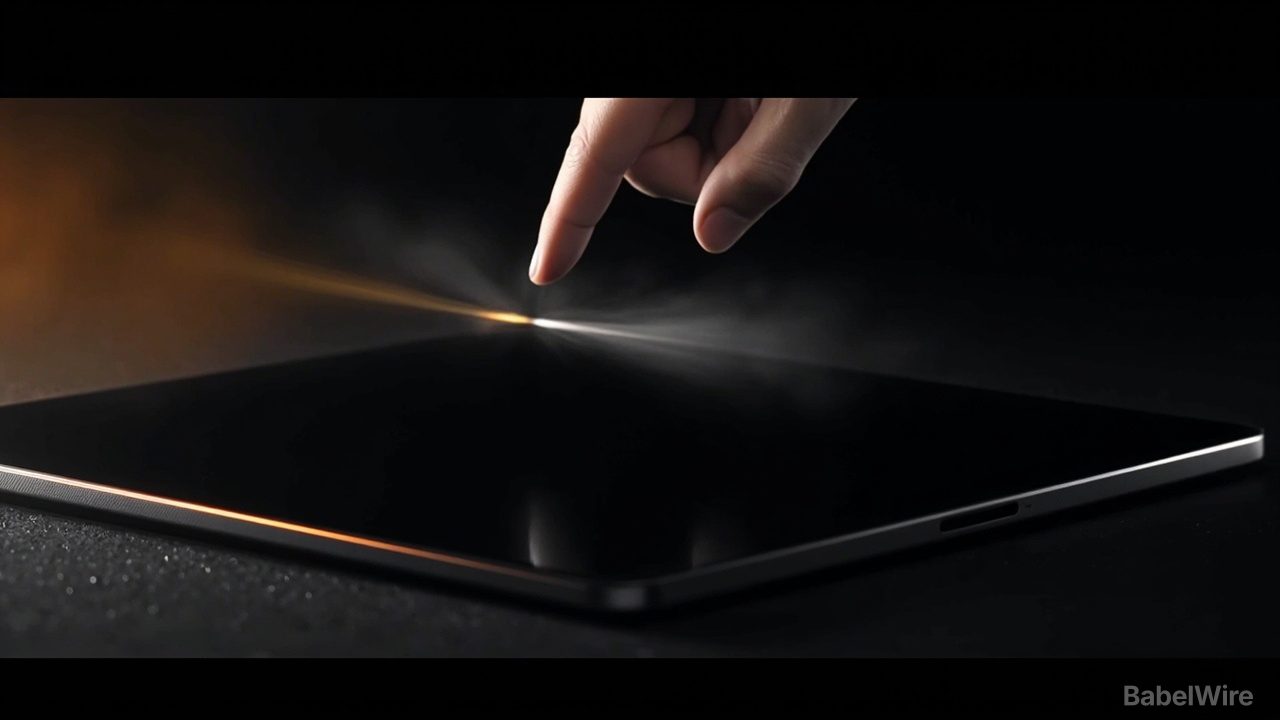
Touch, meanwhile, is deliberately secondary. Reviewers describe macOS adapting around the finger rather than being redesigned for it: contextual menus space out when touch is detected, the traffic-light window controls expand on first tap (a second tap actually hits one), four-finger swipes move between Spaces, pull-to-refresh and flick-to-tile work, and a video-call stabilisation feature compensates for the screen moving when you tap it. 9to5Mac's verdict is blunt — touch is a nice-to-have it kept forgetting about, and the weight loss is the change you feel every day. Steve Jobs's 2010 line that touch surfaces "don't want to be vertical" looks less refuted than routed around.
Two other things arrived: a Dynamic Island on a Mac for the first time, carrying Live Activities and Now Playing, and the glowing Apple logo, back after a decade, driven by its own light because there is no backlight left to borrow.
The awkward part is the silicon. These machines use M5 Pro and M5 Max, the same chips Apple shipped earlier in 2026, and reviewers measured effectively identical performance. Apple is reportedly skipping high-end M6 in favour of a much larger M7 next year, which means the biggest MacBook Pro redesign in five years ships with a chip that may be two generations old within twelve months of purchase.
Pricing makes the positioning explicit: $2,899 for the 14-inch and $3,399 for the 16-inch, a $400 premium over the mini-LED M5 Pro and M5 Max models Apple still sells — which remain heavier, lack touch, and keep the old panel. Until those lines converge, buyers are choosing between the display and the chip cadence.
The read: Apple didn't add touch because it finally believed in it. It added touch because an OLED panel with on-cell sensing made it nearly free, and a lighter 16-inch is the more persuasive upgrade anyway.