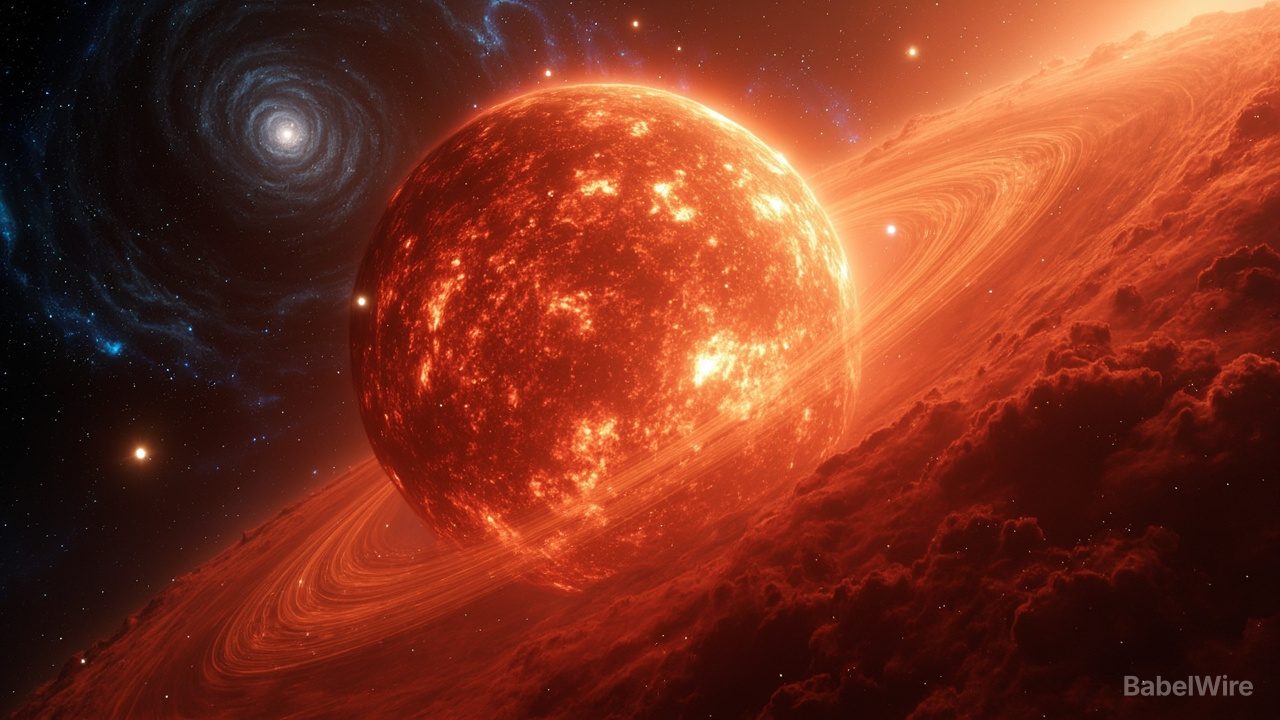
For years, astronomers have puzzled over the "little red dots": compact, blazingly bright red sources in the early universe, seen by the James Webb Space Telescope when the cosmos was less than a billion years old. They look like galaxies, but their spectra defy the usual models. Now a Harvard-led team says a single class of object can explain them: supermassive stars up to 100,000 times the mass of the Sun — and, eventually, the seeds of the first black holes.
The study, led by Devesh Nandal of the Harvard College Observatory, part of the Center for Astrophysics, claims to be the first model that simultaneously accounts for the dots' odd spectra, their ultra-compact appearance and their nitrogen-rich chemistry.
"Little red dots are mysterious because they combine clues that do not usually fit together," Nandal said. "They seem to be telling us that something very luminous is hidden inside dense gas."
Earlier work showed that monster stars with masses around 100,000 Suns can reproduce the unusual hydrogen patterns seen in LRD spectra. The new study asks whether they can also create the dense "cocoons" of gas that make the objects look so compact. Tracking the evolution of known supermassive stars, the researchers found they don't shed mass steadily late in life like ordinary stars; instead they undergo discrete, violent pulsation episodes — "strange-mode" pulsations — that eject shell-like layers of gas.
"The spectrum and the morphology are two sides of the same physical problem," Nandal said. "The spectrum tells us what kind of source is producing the light and how that light is processed, while the shape tells us where the surrounding material is and how compact it must be."
The ejected shells are mostly hydrogen and helium, but they also carry nitrogen — and JWST observations of little red dots are beginning to reveal just such nitrogen-rich spectra, a third piece of evidence. After its last ejection, the star continues to evolve until it undergoes direct collapse, forming the seed of a supermassive black hole — potentially explaining how the universe's earliest giant black holes appeared so quickly after the Big Bang.
"To my knowledge, it is the first model that can explain so many of the observed properties at once, from the spectra to the morphology to the chemical signatures," Nandal said. "Even competing scenarios are now invoking supermassive stars as the central engine."
The team's next goal is to turn these properties into full predictions for the detailed spectra of little red dots, so that James Webb observations can directly test their theory.