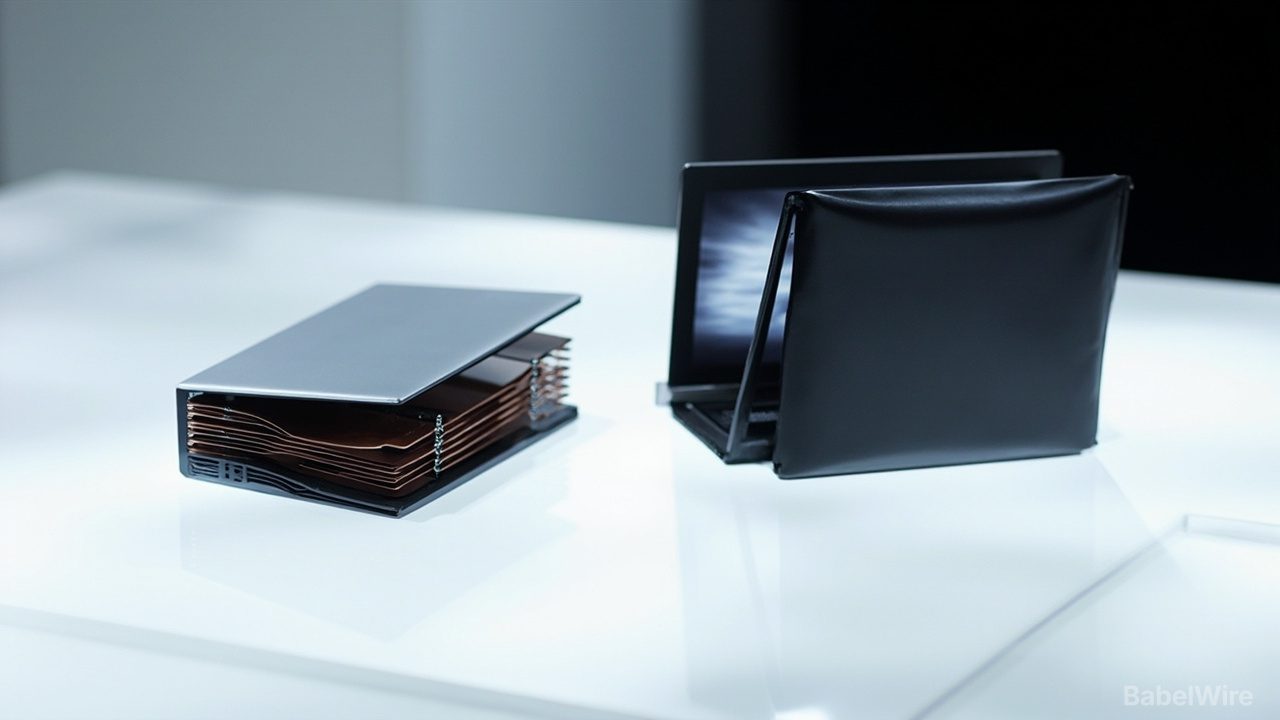
Lenovo used IFA Berlin 2026 to showcase two concept laptops that reimagine fundamental aspects of portable computing — one attacking the thermal problem, the other the screen-size constraint.
Project AeroBlade: Fanless Cooling, Extreme Portability
The AeroBlade Concept is the first laptop to use Frore Systems' AirJet Mini fanless cooling technology, rebranded by Lenovo as the Active Flow Thermal Solution. Instead of traditional fans and heatsinks, the module pulls ambient air and creates 2,000 Pascals of back pressure — roughly 124 miles per hour — through tiny jets onto a copper base layer. Frore claims this disrupts the boundary layer that causes heat buildup and processor throttling.
The result is a laptop that's 10mm thin and weighs just 1.8 pounds — lighter than a MacBook Air — in a magnesium-aluminum body. Four embedded AirJet modules sit along the top of the motherboard. Lenovo says the system uses the same power as a traditional fan but is debris- and water-resistant.
The engineering sample uses an Intel Lunar Lake processor with support for up to 20 watts of thermal design power, suggesting the cooling tech could support higher-performance CPUs. The laptop has an OLED screen and Thunderbolt 4 USB-C ports. Lenovo described the prototype as "very mature and refined" and said it felt production-ready, though no pricing or release timeline was shared.
The AirJet technology is not exclusive to Lenovo, meaning other manufacturers could adopt it in future products.
Project Swan: The Expanding Display
The Swan concept takes a different approach to laptop innovation: a 14-inch display that unrolls horizontally to 17 inches at the push of a button, expanding the screen to a 21:9 ultrawide format. The concept builds on Lenovo's earlier rollable gaming laptop from CES 2026, but with refined mechanics — fewer motors that are more durable.
At 3.5 pounds, the Swan is heavier than the AeroBlade but still portable. Lenovo positioned it as suitable for travel, offering the visual real estate of a larger machine in a compact form factor when closed.
Both concepts illustrate Lenovo's willingness to experiment with form factors that challenge conventional laptop design, even if neither may reach production in its current form.