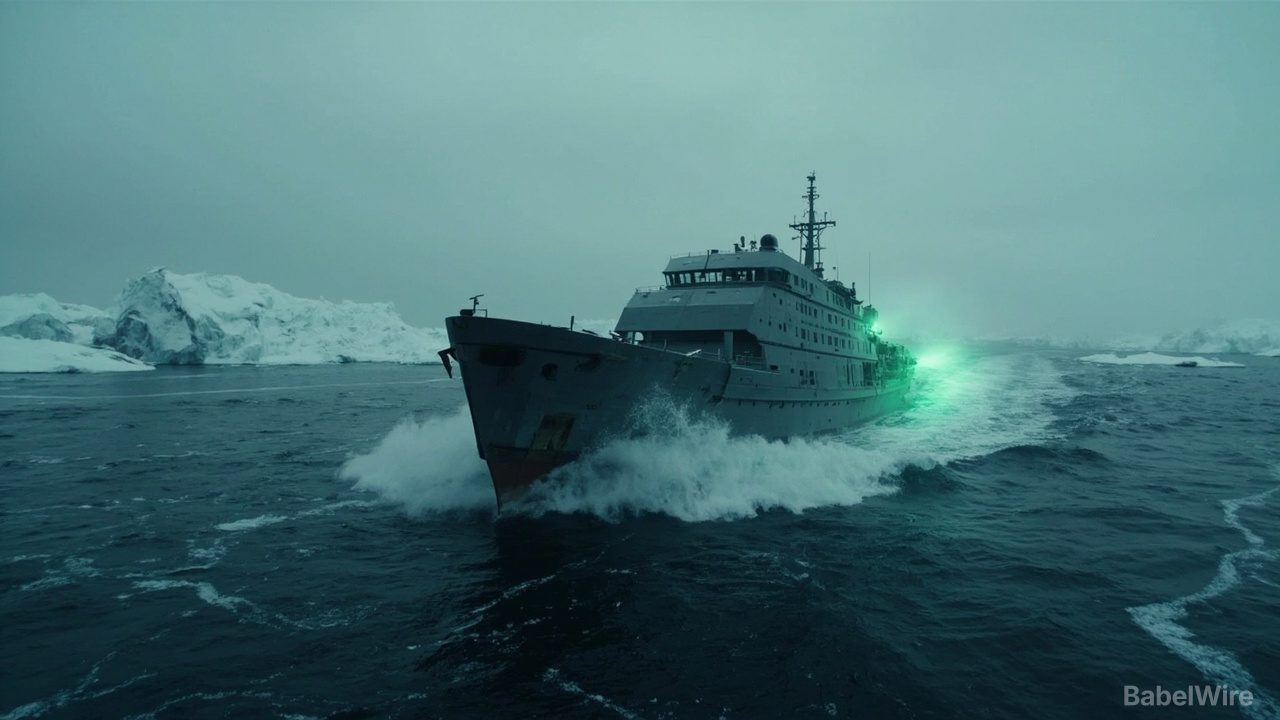
Kongsberg Maritime used 10 November to unveil a class of uncrewed surface vessels rather than a ship. The Arctic Hunter USV is designed to operate alongside crewed vessels in waters beyond the Arctic Circle, and its primary stated job is hunting submarines.
The design brief explains the shape of the thing. Rather than a bespoke hull, Arctic Hunter is based on an existing civilian ship design, which means it can be built quickly on ordinary commercial yards instead of waiting for a naval slipway. Kongsberg then fits its own remote and autonomous control systems; the actual construction is to be done by Balaena Maritime, a long-standing partner, at its yard in Birkenhead in the north-west of England. The target is operational service by the end of the decade.
The sensor fit is British. On the same day, Thales UK and Kongsberg signed a letter of intent covering a UK sonar system for anti-submarine work aboard the vessel, along with a secure military communications package. Kongsberg says the hull also offers spare capacity and deck area for other mission systems, which is the standard way of saying the baseline design is meant to grow.
The requirement being chased is the Royal Navy's Type 92 programme, and the framing from Kongsberg's chief executive Lisa Edvardsen Haugan is about the Atlantic: "Security in the Atlantic is a top priority, and we think the Arctic Hunter USV is a robust and practical answer to the growing need for additional submarine-detection capability." The operational concept is a vessel that sits on station above the Arctic Circle for long periods, launched from bases inside the region, without a crew to rotate or a hull full of provisions to sustain.
What does not exist yet is a contract. There is a letter of intent with a sensor supplier, a yard lined up, and a requirement it is designed against — but no Royal Navy order, and no published unit cost, displacement, endurance figure or sonar specification. That is normal at this stage of a defence programme and also the reason to treat the announcement as an industrial positioning move rather than a capability the fleet has.
The strategic logic is nonetheless real. Anti-submarine warfare in the high north is a problem of persistence and of covering water that is expensive to patrol with frigates; uncrewed vessels are the obvious answer, and several navies are already buying them. Building them from workboat hulls rather than warship hulls is the part that could actually change the price. Whether it works in sea ice, and whether a navy will accept an uncrewed hull in the same patrol box as a manned one, are the questions the end-of-decade deadline exists to answer.



