Astronomers have confirmed the most distant fast radio burst (FRB) ever detected: a millisecond flash of radio energy that left its galaxy when the universe was only about 3 billion years old, and has been travelling towards Earth for more than 10 billion years.
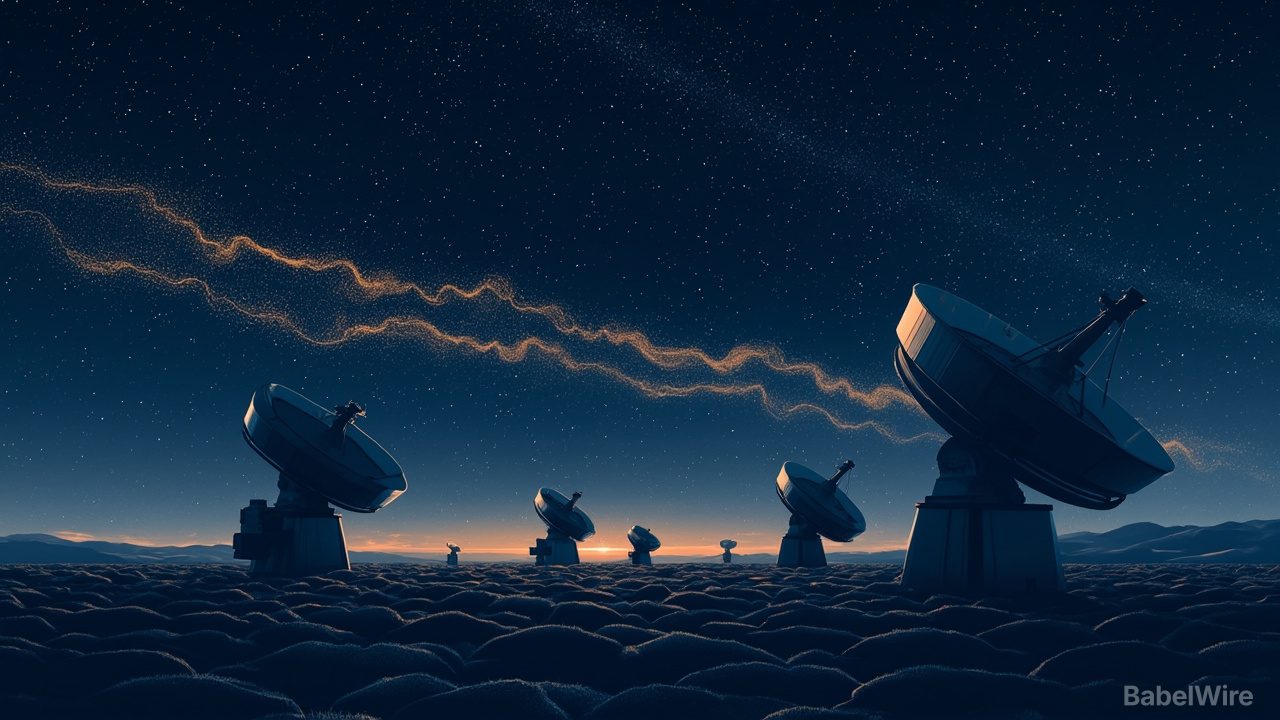
The burst, catalogued as FRB 20240304B, was picked up on 4 March 2024 by the MeerTRAP team using the MeerKAT radio telescope in South Africa's Karoo. Radio data alone suggested it was extraordinarily distant, but proving that required finding its host galaxy — and no ground-based telescope could see anything at that position in the sky. NASA's James Webb Space Telescope solved the problem: its NIRCam instrument found a small dwarf galaxy at the burst's coordinates, and NIRSpec measured a redshift of 2.148, placing the burst about 3 billion years after the Big Bang, roughly 80% of cosmic history away from us.
"The host sticks out in the whole galaxy sample that we have. And it definitely was not what we were expecting," said Ben Stappers of the University of Manchester, a co-author of the study published in the journal Science.
Most FRB host galaxies are massive, well-formed star factories. This one is about 1,000 times less massive than astronomers expected. It is forming stars fast — so fast that most of its stars may have formed within just 30 million years, at the height of "cosmic noon", the era when star formation across the universe peaked.
That detail matters for the long-running question of what makes an FRB. One popular theory involves two neutron stars spiralling together until they merge, a process expected to take billions of years — which would put FRBs in older galaxies with evolved stellar populations. The other leading candidate is a single, highly magnetised young neutron star, a magnetar, which can fire shortly after the supernova that created it. The young, metal-poor dwarf found here fits the magnetar picture far better. "Our work suggests that it's very unlikely that this FRB was produced by a merger," said lead author Manisha Caleb of the University of Sydney.
The burst also acted as a probe of the space in between. "A fast radio burst is almost like a cosmic flashlight. It lights up everything along the path," said co-author J. Xavier Prochaska of UC Santa Cruz. Analysis of the signal revealed the imprint of two structures along the line of sight: a previously unknown galaxy cluster at redshift 0.3, roughly 3.5 billion light-years away, and the nearby Virgo Cluster, about 54 million light-years from Earth.
More than 10,000 FRBs have been logged since 2007, and most are seen once and never again. The team estimates that MeerKAT alone should localise several bursts per year beyond redshift 1, and that JWST will be essential for characterising their hosts — turning these mysterious flashes into instruments for mapping the invisible matter of the cosmos.
Sources
- science.nasa.govWebb Measures Distance to Farthest Fast Radio Burst, Suggesting Origin (NASA)
- theguardian.comAstronomers detect mysterious burst of energy from a galaxy far, far away (The Guardian)
- phys.orgAstronomers pinpoint the most distant fast radio burst ever (Phys.org)
- skyandtelescope.orgFast Radio Burst Shatters Distance Record (Sky & Telescope)
- news.ucsc.eduAstronomers use Webb telescope to pinpoint host galaxy of the most distant FRB (UC Santa Cruz)
- keckobservatory.orgAstronomers Pinpoint Host Galaxy of the Most Distant Fast Radio Burst (W. M. Keck Observatory)