A Planet Where the Surface Is Liquid Rock
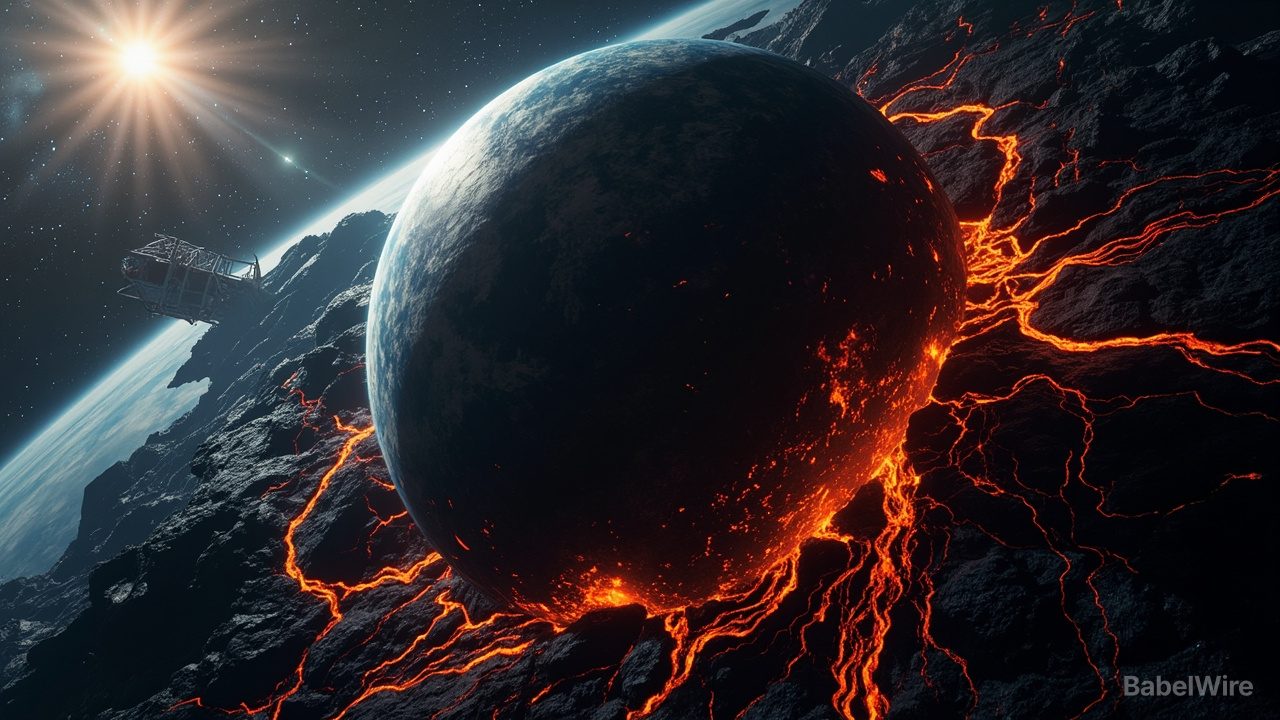
Forty-one light-years from Earth, a world orbits its star so closely that a year lasts just 17 hours. Its surface temperature is hot enough to melt rock. The planet, 55 Cancri e, is a super-Earth — about 1.88 times Earth's radius and 8 times its mass — and new observations from the James Webb Space Telescope are revealing just how extreme this world really is.
A team of scientists, led by Ignas Snellen at Leiden University, used JWST's NIRCam instrument to observe five eclipses of 55 Cancri e as it passed behind its Sun-like host star. By analyzing the light passing through its atmosphere, they were able to determine its chemical composition for the first time.
A Hydrogen-Rich Atmosphere from a Magma Ocean
The results, submitted to Nature Astronomy, show that 55 Cancri e likely has an atmosphere rich in hydrogen, carbon monoxide (CO), and smaller amounts of carbon dioxide (CO2). This composition is strikingly different from what standard models of lava planets predicted — and the source appears to be the planet's own molten interior.
The scientists concluded that the atmosphere is being fed by outgassing from a reduced magma ocean — essentially, volcanic activity on a planetary scale. The preference for hydrogen over oxygen suggests an interior with relatively low oxygen fugacity, consistent with a magma ocean that is actively releasing gases into the thin envelope above.
Variability Points to Volcanic Clouds
One of the most intriguing findings was variability across the five eclipses. The team observed differences in the atmospheric signal that could point to outgassing events or clouds produced by that outgassing. These clouds could briefly cool the surface before fresh outgassing clears them away — a dynamic, ever-changing landscape of molten rock and volcanic haze.
Why Lava Worlds Matter
55 Cancri e is part of a growing catalog of lava exoplanets discovered in recent years, including K2-141 b, L 98-59 d, TOI-561 b, and CoRoT-7 b. Unlike Jupiter's moon Io, whose volcanism is driven by tidal forces, these worlds are heated by the extreme radiation of their host stars. Studying them helps scientists understand planetary formation, interior chemistry, and the range of possible worlds in the universe.
As the fictional PhD student in planetary volcanology might say in the year 2158: the data from JWST is giving us the first real glimpse of what these worlds are made of — and the picture is more dramatic than anyone imagined.