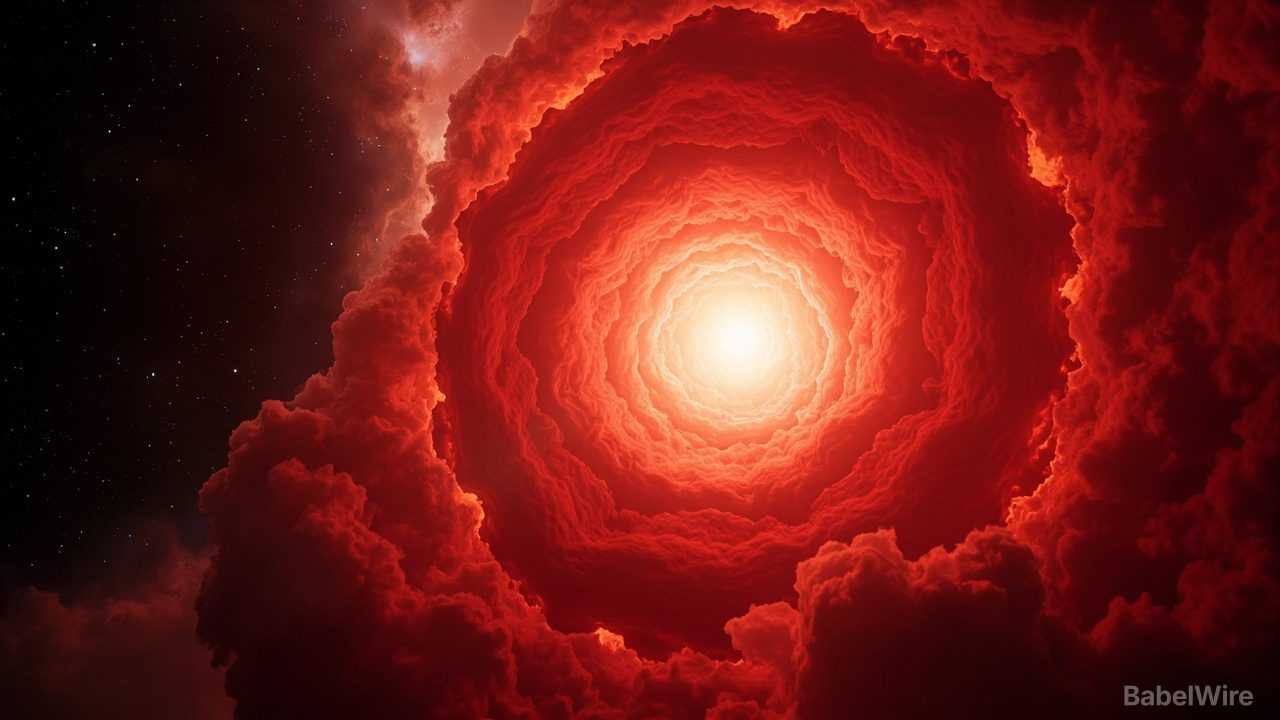
Astronomers from MIT and other institutions have identified an exceptionally bright red object dating back to the early universe. At first glance, it resembles an enormous star with dimensions comparable to our solar system. Its energy output, however, is extraordinary: the object is producing roughly 100 billion times more energy than any known star could physically generate, putting its power much closer to the levels associated with black holes.
That unusual combination has led researchers to propose that the red object represents an entirely new kind of astrophysical source. They are calling it a "black hole star." A study published on August 12 in Nature describes the object and the team's analysis of observations made with NASA's James Webb Space Telescope (JWST), which detected the bright red dot in the very early universe, only a few hundred million years after the Big Bang.
Instead of being powered by the nuclear fusion that fuels ordinary stars, the object may consist of an extremely dense cloud of gas energized by a black hole at its center. "Our picture of this object is evolving very rapidly," says lead author Rohan Naidu, a NASA Hubble Fellow and Pappalardo Fellow at MIT's Kavli Institute for Astrophysics and Space Research. "We think there is a central black hole that is 100,000 times as massive as the Sun. And around this black hole, there would be this very extended envelope of gas that looks like a star the size of the solar system. It's huge."
The team named the object MoM-BH*-1 after the "Mirage or Miracle" (MoM) survey in which it was found. Among its oddities: a record-breaking "Balmer break" — the deepest ever observed in any object — that ruled out ordinary stars as the source, and light showing almost no evidence of elements other than hydrogen and helium.
If the interpretation holds, black hole stars could account for many of the "little red dots" that have appeared in nearly every deep JWST image. "Every little red dot is consistent with being a black hole star, embedded in a generic early galaxy," Naidu says. "What is special about MoM-BH*-1 is, the black hole star is essentially completely outshining its surrounding host galaxy." The discovery could provide an important clue to one of the most debated mysteries of the JWST era — and reveal a type of cosmic object never directly observed before.
Sources
- sciencedaily.comScienceDaily: JWST spots a bizarre 'black hole star' 100 billion times brighter than a star
- news.mit.eduMIT News: Astronomers discover a brand-new type of astrophysical object — a black hole star
- psu.eduPenn State News: Mysterious 'red dots' in early universe may be 'black hole star' atmospheres
- sci.newsSci.News: Astronomers Find Black Hole Star in Early Universe