Astronomers using NASA's IXPE (Imaging X-ray Polarimetry Explorer) have gathered the most convincing evidence yet for a prediction made 90 years ago: that empty space itself can bend and filter light when bathed in extreme magnetic fields. The results were published Wednesday in the journal Nature.
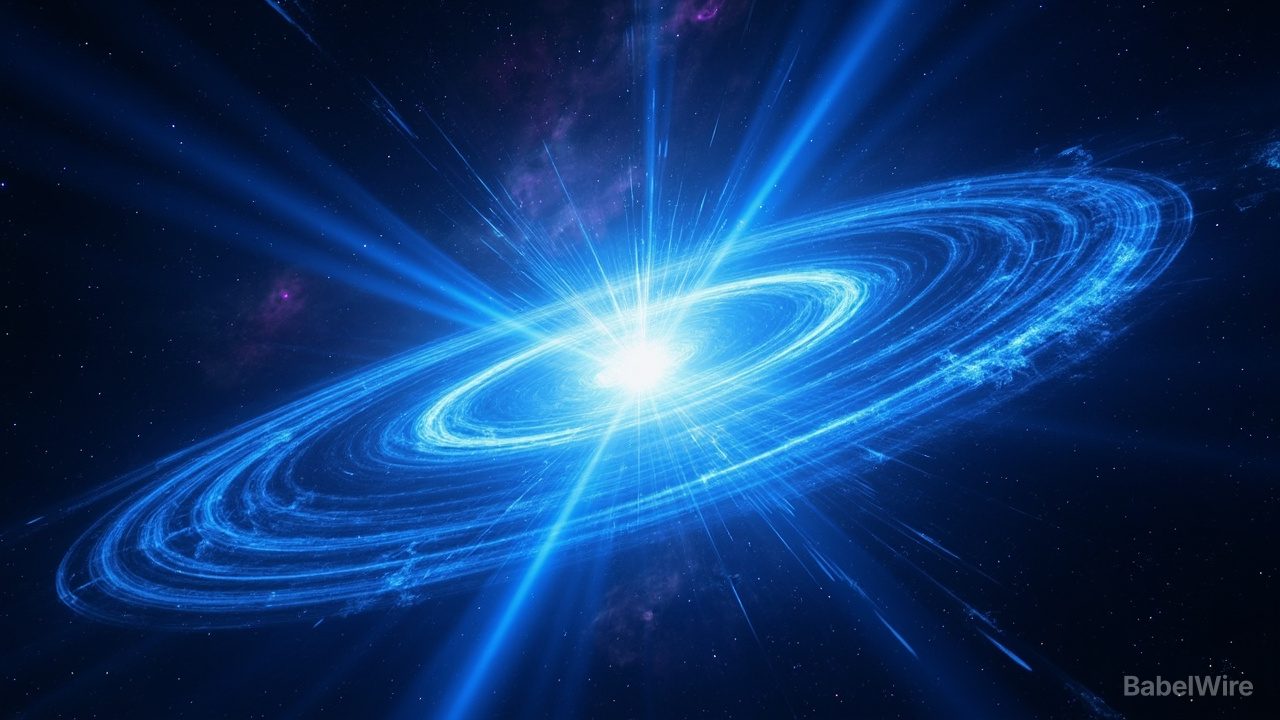
Between March and April 2025, the team spent more than 140 hours observing the magnetar 1E 1547.0-5408 — a rapidly rotating neutron star with magnetic fields roughly a trillion times stronger than Earth's — with IXPE, NASA's NICER telescope and Murriyang, CSIRO's Parkes radio telescope in Australia. It was the first-ever coordinated radio and X-ray polarization measurement of a magnetar.
The observations showed that the polarization of the incoming X-rays — the orientation and alignment of the photons — was nearly three times greater than seen in similar sources. That was surprising: the geometry of the magnetar's magnetic fields suggested the measurement should be close to zero at certain points, and standard surface emission models cannot explain such a large value. Something else, the team concluded, must be boosting the polarization.
The likely culprit is vacuum birefringence, a theory first proposed in 1936 within quantum electrodynamics. It holds that under magnetic fields far stronger than anything achievable on Earth, the vacuum acts like a lens or a prism, filtering light based on the direction it travels and enhancing its total polarization. Simulations by the research team, including co-lead author Hoa Dinh Thi of Rice University, support that interpretation.
"Our model suggests that reproducing the observed X-ray polarization signatures requires the presence of vacuum birefringence in the neutron star's environment," said Dinh Thi. "This finding exemplifies how neutron stars enable us to test fundamental physics in environments not replicable in labs on Earth." Rachael Stewart, a Ph.D. candidate at George Washington University and lead author of the Nature paper, added: "The information we obtained from looking at this distant star core also gives us clues about the nature of the fabric of reality as we know it." Further IXPE observations of this magnetar and others will aim to confirm the signal and reveal other exotic quantum electrodynamics effects.