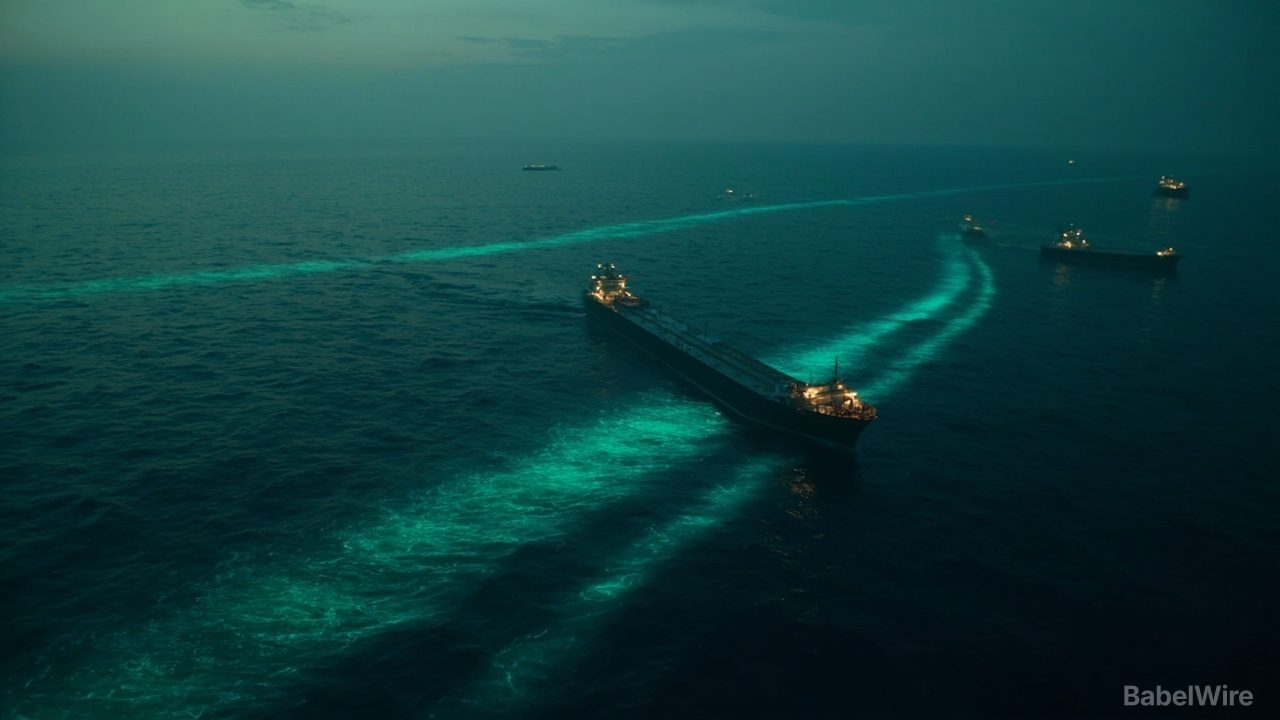
The ships have no cargo and no reason to be there.
Windward, a maritime intelligence firm, tracked three sanctioned tankers and an Iranian fishing boat drifting over major undersea cable corridors in the Gulf of Oman through October, according to reporting by the Financial Times. Two of the tankers spent days directly above regional cable routes with, in Windward's words, "no commercial reason to stop." Some of the vessels then went dark, switching off the AIS transponders that broadcast their position and course.
The timing is the message. Iranian officials and commanders of the Islamic Revolutionary Guard Corps have spent the autumn warning that they could attack the cables under the Strait of Hormuz if the United States resumes large-scale strikes. "Seven major cables run through the Strait of Hormuz, supporting global Internet operations and commercial data transmission," an IRGC spokesperson said on October 20. "We remind the enemy of this."
Six active cables cross the strait, linking the Middle East to Europe, Africa and Asia, with two more under construction in the region. Four countries — Iraq, Kuwait, Bahrain and Qatar — depend entirely on those routes to reach the outside world. A third of India's westbound internet traffic runs through the Persian Gulf and the strait.
One of the corridors the ships visited belongs to 2Africa, a cable consortium that includes Meta. Its expansion is already paused, because the small global fleet of cable-laying ships has not been able to operate safely in the region since the war began in February 2026.
That is the part planners should find unsettling: the repair fleet is the same bottleneck as the attack surface. Damage that would normally be fixed in weeks could take months.
Windward considers two readings plausible — the ships are mapping cable routes, or they are placing charges and mines while dark. Neither can be proven. The evidence is behavioural: slow drifting, looping over known routes, no cargo, no destination, intermittent silence.
Iran has already demonstrated in this war that it treats digital infrastructure as a target, launching repeated drone strikes on Amazon data centers in the region. In May 2026 an IRGC spokesperson claimed Iran would "impose fees on Internet cables" owned by US tech companies and others. The fee rhetoric has since hardened into a threat of physical destruction.
Why this is more than a regional story: subsea cables are private property with public consequence. There is no no-fly zone for the seabed, no inspection regime that stops a ship from circling, and no institution that reliably punishes an attack on a cable in international waters. What is left is deterrence through visibility — and the alternative route.
That route is now being built. Gulf states and US technology companies are accelerating land and bypass paths around the chokepoint. It takes years and billions. Cutting one cable takes minutes.