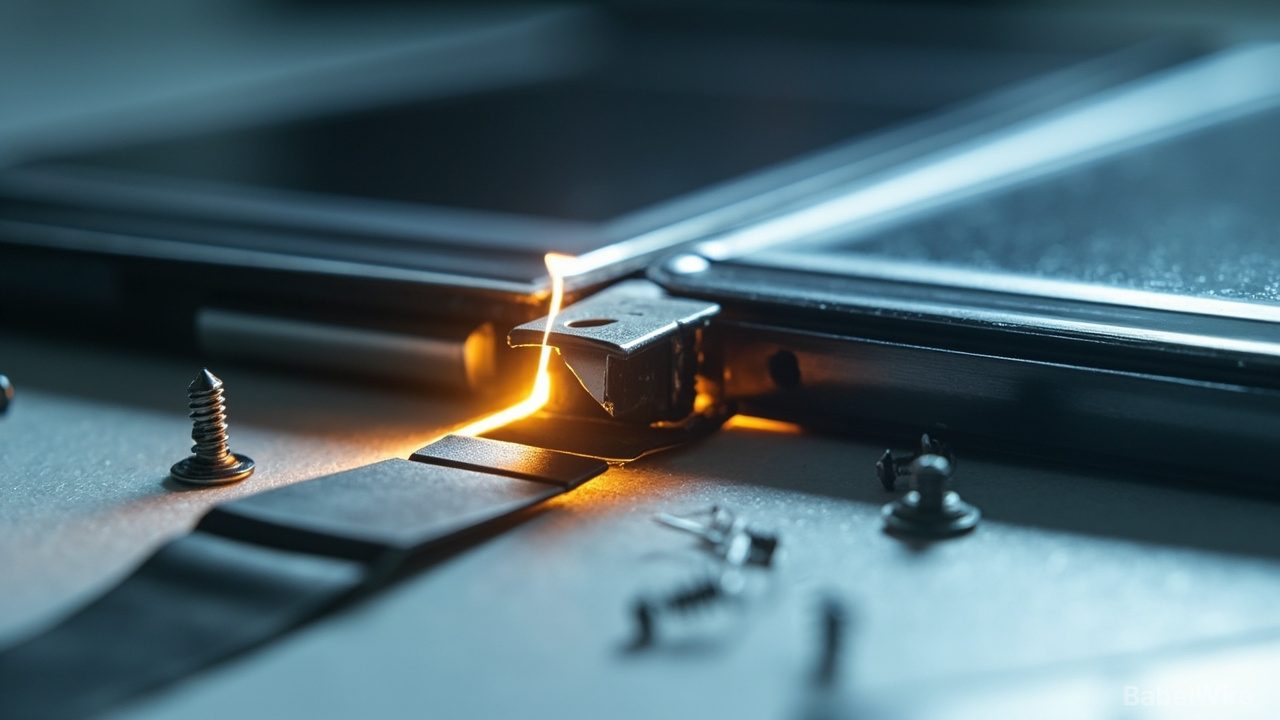
iFixit published its iPhone Duo teardown on Sunday, and inside it built a working 3D model of the hinge. The spot where stress converges in that model sits almost exactly where owners are photographing broken screens. iFixit is explicit that this proves nothing yet.
Three candidates, one location
To build the model, iFixit combined CT scans from a Lumafield Neptune scanner, teardown footage and Apple's own patents, then compared the model's stress points against the damage locations reported in forums and on the iPhone Duo subreddit. Three mechanisms fit:
- A central support bar that does not retract far enough as the phone closes. The display's curved fold comes down onto it, producing a small hotspot. - Curved guide rails that rise above neighbouring components during folding and could interfere with the screen if they fail to travel as intended. - Least satisfying, hardest to rule out: several structural edges converging at one spot, concentrating stress in display layers that are microns thick and already moving independently of each other.
Why the location matters more than the theory
The failures are not where everyone first assumed — not at the gap where the display's flex cable crosses the hinge. They cluster slightly below it, at the transition to the central support, where several edges meet and change how the thin display is supported mid-bend.
That geography is what makes the hypothesis interesting. A plausible mechanism that lands exactly where the damage lands is worth considerably more than a plausible mechanism on its own. It is also worth less than a diagnosis: the teardown does not establish cause, and several reports that iFixit "found" it overstate the finding. What exists is a public interactive CT scan of the hinge that anyone can inspect.
A reproduced failure came first
Earlier in the week, a YouTuber reproduced the crack during a durability test, then opened the phone. His finding: the hinge is a gear-like central mechanism plus two kinds of linking hinges; the part that broke was one of the middle links, thinner than its neighbours, and it snapped at a small notch. There were also witness marks where the hinge met the support plate — something was catching before anything cracked.
iFixit's model is the structural explanation for that single case, and the reason the conversation has moved from "my display cracked" to "this geometry is loaded".
The counterweight nobody is quoting
On 24 October, AppleInsider asked long-standing contacts who staff Genius bars in seven Apple Stores, four of them major flagships. None had taken in a Duo for service or return because of a broken screen.
That is the only attempt anyone has made to measure incidence rather than count photographs, and it points the other way. It is also a launch-week sample of seven stores in one country, and most buyers with a dead inner display would go through AppleCare or a carrier first. Both can be true: a genuine mechanical weak point in a small number of early units, and an internet overstating how common it is.
Apple has issued no statement and announced no service program.
Best foldable yet — still a bear to repair
Provisional repair score: 5 out of 10, the highest iFixit has given a foldable. The Galaxy Z Fold8 and Pixel 11 Pro Fold both scored 4. The score is provisional because replacement parts are not yet in Apple's self-service program.
The bright spots are real. There is a repair manual on day one. The outer display lifts off intact, which matters because most internal repairs have to go through it. The two batteries use the electrically-released adhesive Apple introduced with the iPhone 16 — iFixit called it the best battery removal experience it has had on a foldable. And the nano-texture cover layer is designed to be replaced: $19 with AppleCare+, $49 without.
The number that actually matters is the inner display, at $999 without coverage. Removing it means getting through a lot of adhesive, and the flexible panel is delicate enough that disassembly itself risks tearing it.
The dust test, and a spec-sheet gap
iFixit worked the phone open and shut inside a bag of fluorescent powder. Dust reached the USB-C port, speaker mesh and bezel; little reached the internals. Particles did get into the hinge, which started crunching almost immediately — though less than in the Galaxy Z Fold8 or Pixel 11 Pro Fold under the same test. Cleaning it out means removing the flexible display and its supports.
iFixit also flagged something the spec sheet implies but does not say: IP68 covers the enclosure, and in a foldable the hinge mechanism sits largely outside that definition. Dust resistance and hinge cleanliness are not the same promise.
Two more teardown notes: the Duo uses an unstacked, single-layer logic board — the first iPhone to do so since the iPhone 8, one of the ways Apple kept it thin — and Apple describes the inner display as a 10-layer stack, which iFixit peeled back layer by layer under a microscope.
What this means if you own one
A mechanical fault that appears within hours is manufacturing or assembly, not wear. That falls under warranty, and everyone who received a Duo in the last week is still inside the return window.
Document the phone before anything happens: photograph both screens and the hinge, keep the receipt. If you hear a crunch or see a bright line, stop folding it and contact Apple rather than waiting to see whether it spreads. Watch for a service program in the next two weeks; the CT model is the reason the reporting got this far, this fast.