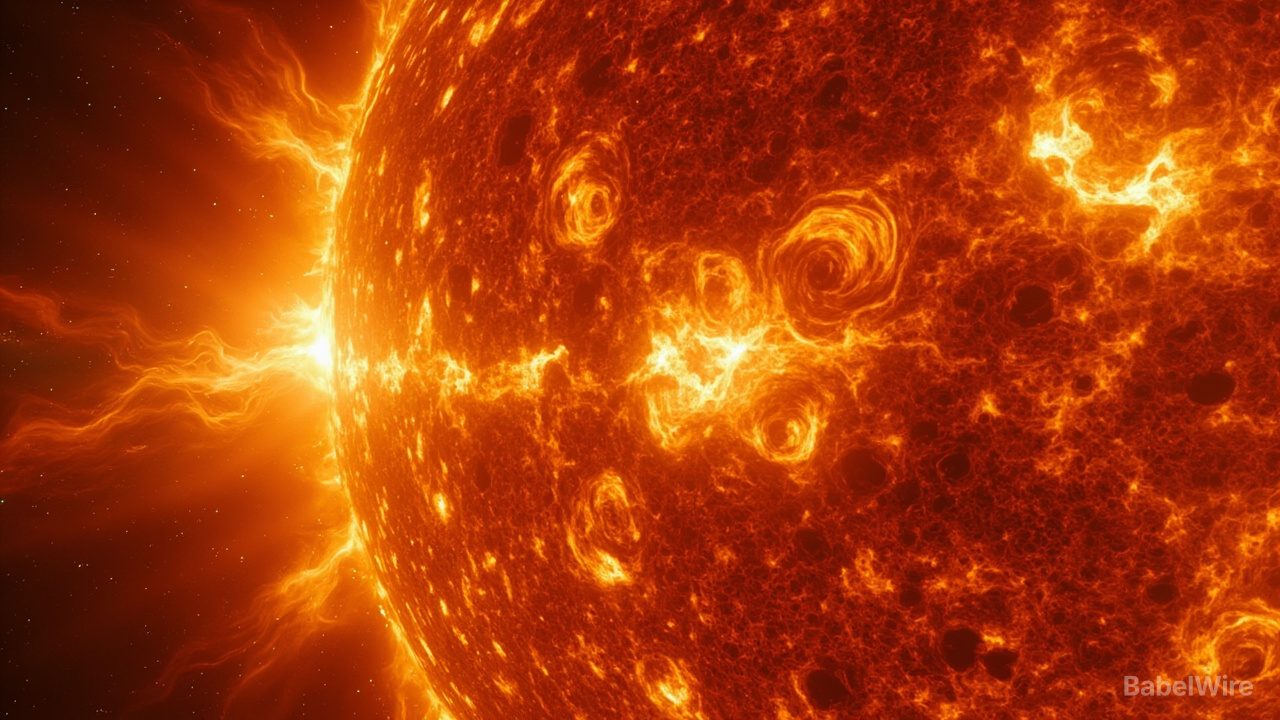
The most powerful solar telescope on Earth has captured the highest-resolution images of the Sun's surface ever taken — and revealed a hidden landscape of whirling vortices so widespread they may help explain some of the Sun's biggest mysteries.
The NSF's Daniel K. Inouye Solar Telescope in Hawaii found that the Sun's surface is teeming with Kelvin-Helmholtz instabilities (KHI): spiral, wave-like patterns that form where two fluids slide past each other, similar to ocean waves or certain cloud formations. These features had been predicted by theory for decades but never before observed on the Sun — previous instruments simply lacked the resolution to see them.
In April 2025, the telescope stared at a magnetically active region near a sunspot, capturing a time-lapse of the roiling solar plasma. When the team processed the data, they immediately recognized the telltale signs of KHI vortices — but confirming them required both the highest-resolution data ever acquired of the solar surface and the most complete numerical simulations ever run for this purpose.
The work paid off in more than confirmation. The observations suggest KHI are not isolated disturbances but an almost ubiquitous feature of the boundaries between magnetic structures and the bubbling convection around them. The whirlpools form when fast-moving plasma shears past slower plasma at magnetic boundaries — and they appeared everywhere the team looked.
'We were truly amazed by the incredible amount of small-scale detail and dynamic activity visible in the high-resolution images,' said solar physicist David Kuridze of the US National Solar Observatory. 'What really surprised us was just how many KHI events we found. Seeing how truly omnipresent they are across the magnetic surface was something we really didn't expect at all.'
If KHI are as widespread as the observations suggest, they could be influencing the flow of energy through the solar atmosphere almost everywhere — mixing plasma and magnetic fields as they twist and break apart. Understanding those small-scale processes is a step toward explaining larger mysteries, such as why the Sun's outer atmosphere is so unexpectedly hot, and what kicks off the enormous eruptions that drive space weather. The findings were published in Nature.