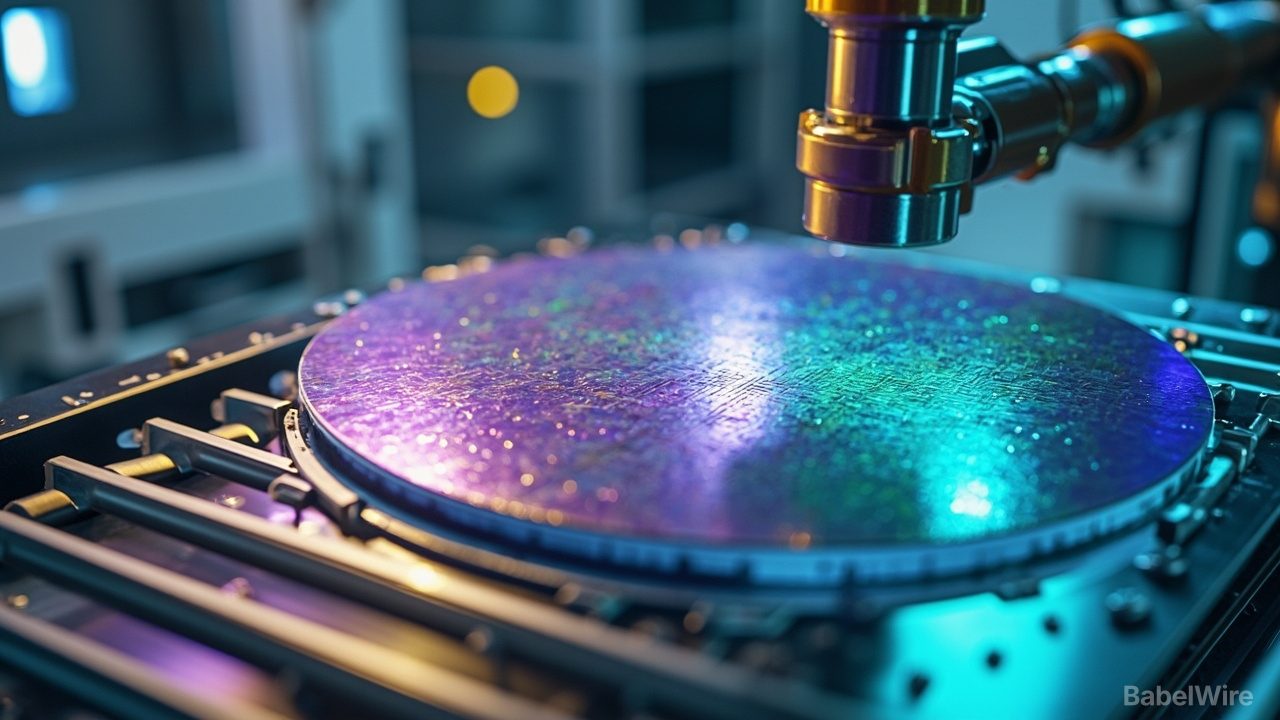
Infineon will build what it calls the world's first high-volume production line for gallium nitride power semiconductors on 300-millimeter wafers, converting an existing cleanroom in Villach, Austria, with output planned for the end of 2027.
The investment is about 1.1 billion euros. Up to 319 million of that is expected from the European Union under the Chips Act, though the formal allocation from Austria's economics ministry is still pending. Chancellor Christian Stocker called it one of the largest single investments in the history of Austrian high-tech industry. Economics minister Wolfgang Hattmannsdorfer noted that Europe accounts for only about ten percent of global chip production, while Austria leads the EU in semiconductor research spending per capita.
Why 300 millimeters matters: the wafer is the substrate, and a larger one yields more dies per run. Silicon has been made on 300mm for two decades; silicon carbide is only now migrating there; GaN has largely been made on 200mm or smaller. Infineon says it cracked the 300mm GaN process about two years ago, and the company positions the line as completing a portfolio that spans silicon, silicon carbide and gallium nitride.
The physics: GaN is a wide-bandgap material, which lets it switch high currents at high frequencies with low losses, at blocking voltages up to 1,700 volts. The consequences are smaller and lighter solar inverters, chargers, motor drives and power supplies — including the racks that feed AI accelerators. Infineon argues that GaN switches even faster than silicon carbide and, in its telling, will not cost more.
Villach is already the company's global competence center for power electronics and new semiconductor materials: around 5,800 employees in Austria, 2,500 of them in research, 4,800 at the site. Infineon puts Europe's share of the power electronics market at roughly 40 percent, which is the strategic subtext — the EU is not trying to win the leading-edge logic race here, but to hold the part of the semiconductor stack where it is already strong.
One number to watch: volume. A 300mm line only pays off if GaN demand arrives at automotive and grid scale rather than staying in premium chargers. Infineon's answer is that AI power delivery, electrification and robotics all need the same thing — more current switched more efficiently in less space.