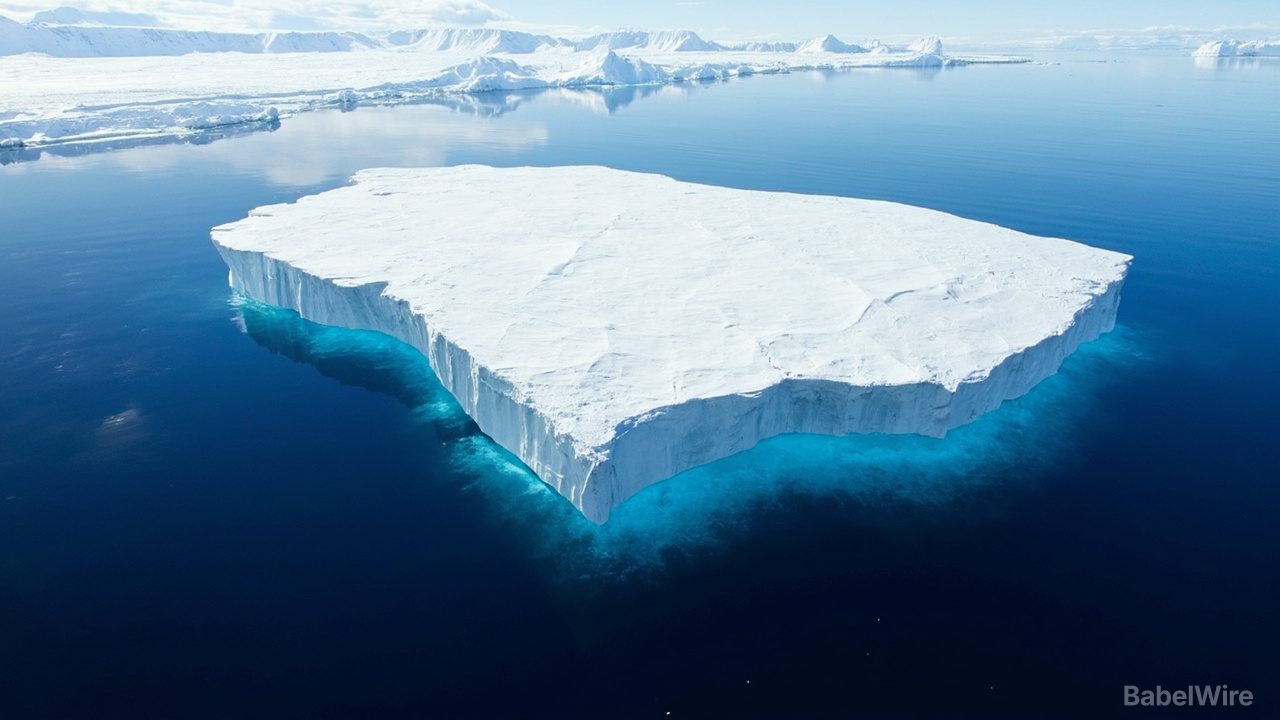
Petermann Glacier, one of Greenland's largest remaining ice tongues, calved a tabular iceberg roughly the size of Manhattan Island on August 4, 2026. The 76.4 km² ice island — estimated to be up to 150 meters thick — detached from the glacier's floating ice tongue in the largest Arctic calving event since 2020.
The break was detected by Adam Garbo, a doctoral student at the University of Ottawa, using satellite imagery from the European Space Agency's Sentinel-1 mission. The team, which includes researchers from the University of Stirling, Environment and Climate Change Canada, Lancaster University, and the University of Leeds, had been monitoring the glacier since 2019 and had anticipated the event.
"Petermann Glacier has long been one of Greenland's largest remaining ice tongues," said Garbo. "We've anticipated this break for years, and seeing it finally happen is remarkable."
But the story doesn't end here. Researchers say two additional large ice islands are expected to detach in the near future as long-developing rifts continue to cut across the ice tongue. Those future calving events are projected to produce ice islands of approximately 94 km² and 84 km² respectively. Together with the newly detached ice island, they would reduce the Petermann ice tongue by about 254 km² — roughly 22% of its total area.
Large Arctic ice islands are far rarer than the tabular icebergs regularly seen in Antarctica. Because they can persist for years and drift across polar waters, they offer both a scientific window into glacier retreat processes and a practical hazard for Arctic shipping and offshore operations.