The universe has just become a much louder place.
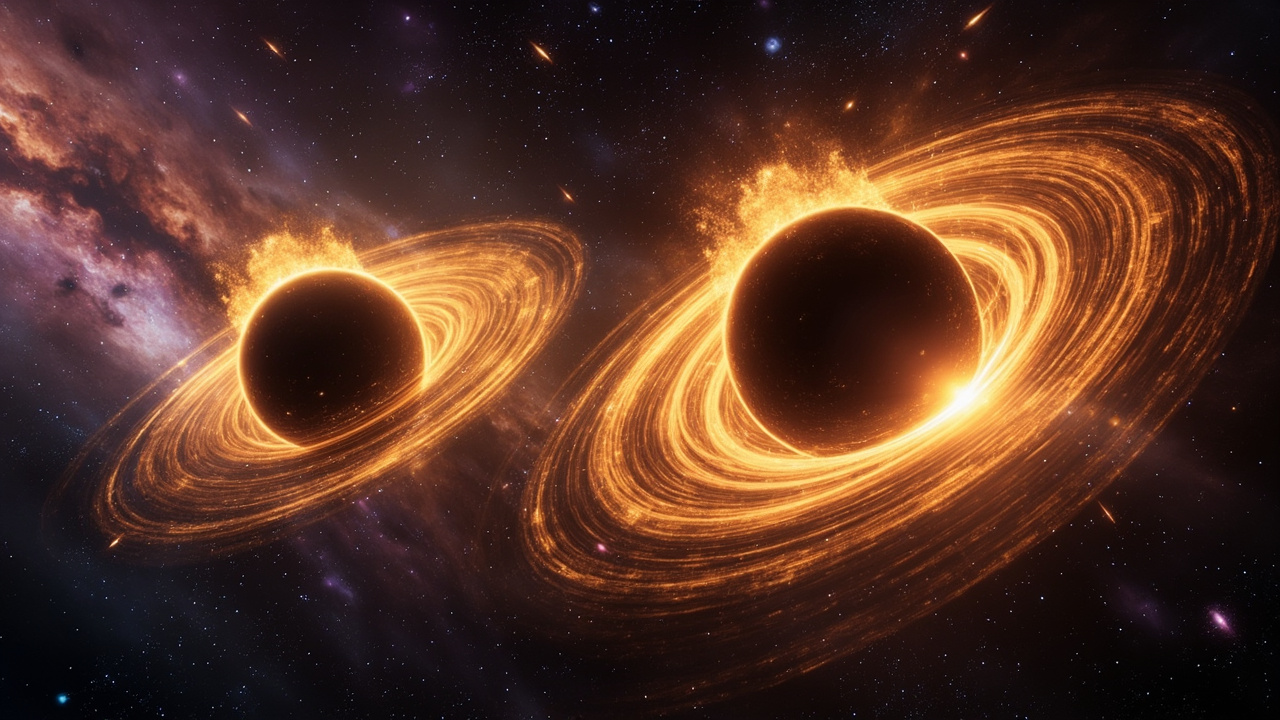
The LIGO-Virgo-KAGRA (LVK) collaboration has released the Gravitational Wave Transient Catalogue-5.0 (GWTC-5) — the largest catalog of gravitational wave detections ever published, revealing 161 newly identified signals from colliding black holes and pushing the total confirmed count to 390 events.
Just ten years after the first direct detection of gravitational waves in 2015 — a discovery that earned the Nobel Prize in Physics — the field has entered an era of routine discovery. The LVK detector network now picks up roughly three to four gravitational wave events every week as instruments grow increasingly sensitive.
"This bumper update has once again broadened and deepened our knowledge of the Universe, and given us many more glimpses of its most elusive objects: colliding black holes," said Dr. Daniel Williams of the University of Glasgow, which has been at the forefront of gravitational wave science since the 1970s.
The catalog contains several landmark discoveries:
- The clearest signal ever recorded — Known as GW250114, this event achieved a signal-to-noise ratio (SNR) of 76.9, making it the strongest gravitational wave detection on record. It was produced by two black holes of 32 and 34 solar masses merging over one billion light-years away. The clarity allowed scientists to perform the most precise tests of general relativity ever conducted from gravitational waves and to confirm Stephen Hawking's black hole area theorem.
- The most precisely located source — Event GW240615 was localized to just six square degrees of sky, the most accurate sky localization ever achieved. It came from two black holes of 26 and 30 solar masses merging more than three billion light-years away.
- Evidence for second-generation black holes — Two events from late 2024 (GW241011 and GW241110) show black holes that may themselves be products of earlier black hole mergers. Their unusual spin signatures suggest they formed in dense stellar clusters where repeated mergers are possible.
The expanded catalog is also helping tackle one of cosmology's biggest questions: the Hubble constant, which describes the Universe's expansion rate. Using 236 signals — nearly double the previous dataset — researchers achieved the most precise gravitational-wave-based measurement yet.
"It's the astronomical equivalent of uncovering an ancient civilisation," said Williams. "Today's new results are like finding a previously undiscovered hoard, revealing not just individual lives, but the structure of an entire lost world."