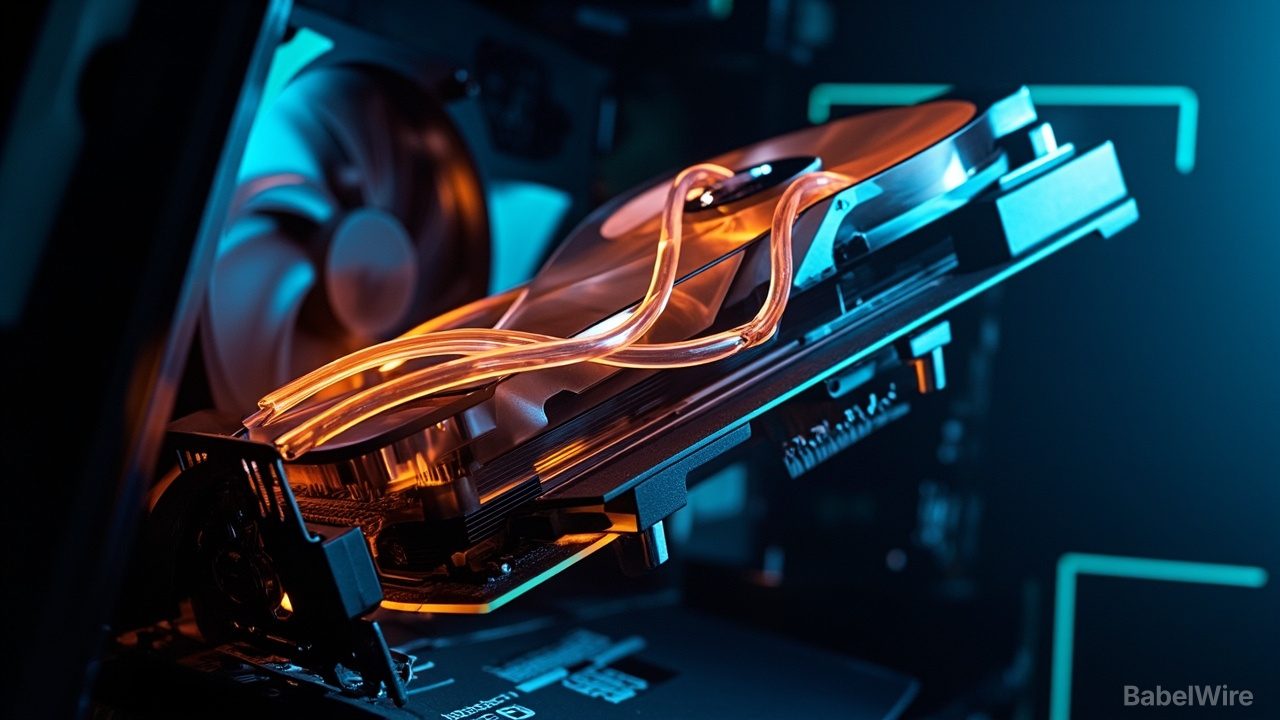
German tech outlet Golem reports that an unusual mounting position for a graphics card significantly lowers its operating temperature — a reminder that in PC thermals, geometry can matter as much as fan speed.
The mechanism is older than modern GPUs. Most graphics-card coolers move heat through heat pipes: sealed copper tubes holding a small amount of fluid that evaporates at the hot end and condenses at the cool end, carrying heat out to the fins. The return path depends on a wick and, in many designs, on gravity. Turn the card so the cold end sits level with or below the hot end and the wick has to work against gravity; hold it the other way and condensed fluid drains back more easily.
That is why orientation can shift temperatures by several degrees without any change to the fan curve: the cooler is doing the same job with a different amount of help from physics.
Beyond orientation, the report points at the practical variable many builders ignore: space. A card whose fans draw cool air from an unobstructed area, away from the power supply and other heat sources, will run cooler than one wedged against a panel or starved of intake.
A caveat worth keeping: enthusiasts have measured orientation effects for years, and one test does not establish a rule for every case. How large the effect is depends on the cooler design, the case and the airflow route. For anyone chasing a few degrees, though, rotating the card is a free experiment — no new fans, no extra noise budget.