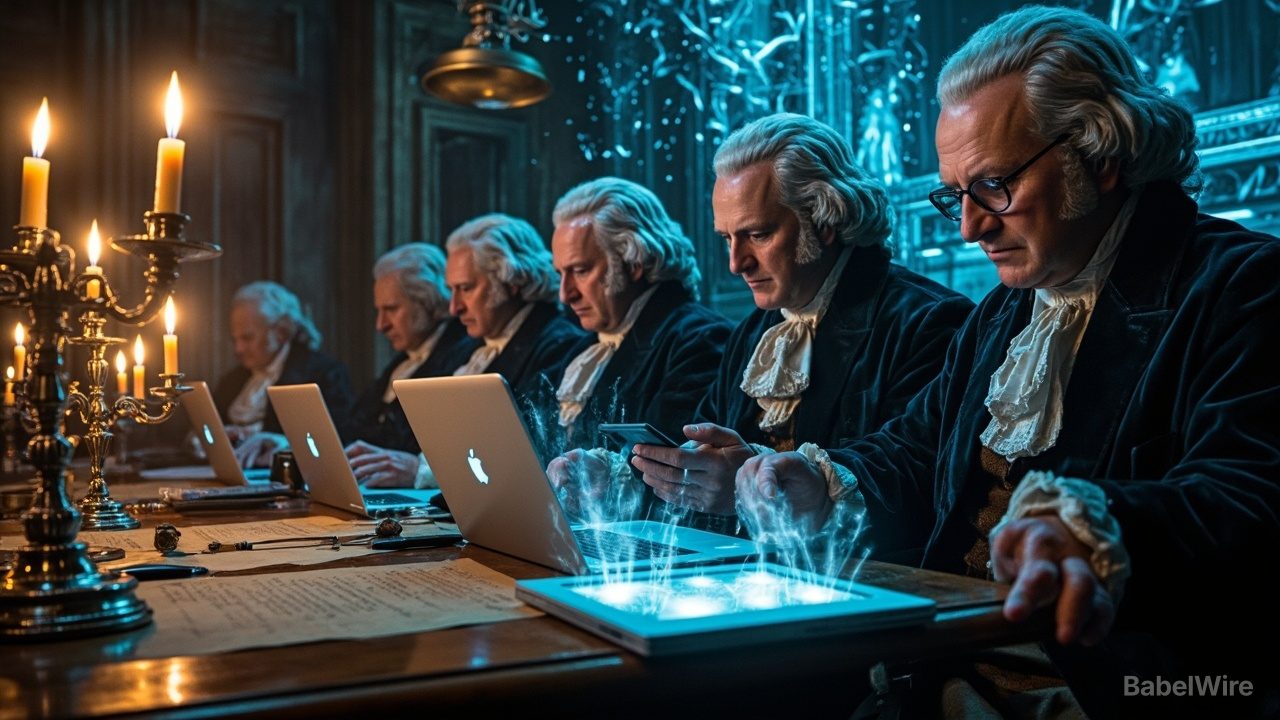
Google has kicked off America's 250th birthday with a commercial that's as buzzy as it is controversial — reimagining the Founding Fathers drafting the Declaration of Independence using Google Workspace and Gemini AI.
The ad, titled "Group project, but make it 1776," opens with a largely unseen Thomas Jefferson mid-draft when he gets a nagging text from Benjamin Franklin. What follows is a very Google-centric collaboration: edits are suggested in Google Docs, a meeting gets scheduled in Google Calendar and conducted via Google Meet (with every attendee apparently turning their camera off), and the final document is e-signed as fireworks explode.
AI plays a starring role. The fictionalized founders use Google's "help me visualize" AI tool to try out different animals on the national seal (the bald eagle wins). Gemini takes notes on the meeting. The founders even consult the chatbot for advice before declining King George III's document access request.
The commercial is deliberately tongue-in-cheek — at one point Sam Adams asks, "Can we settle this over beers?" — and avoids the misstep of earlier Google AI ads by not suggesting AI could improve the actual text of the Declaration. The most AI-forward element may be the footage itself, which has the uncanny glow of AI-generated video.
Reactions have been sharply divided. Viewer comments on YouTube and Instagram are mostly positive, with audiences appreciating the lighthearted approach and relatively restrained AI marketing. However, the response on Bluesky has been far more critical, with users calling the ad "cringey," "stunningly tone deaf," and questioning the appropriateness of inserting AI into a foundational moment of American history.
Historian Angus Johnston noted the irony: "Even in a corny fantasy joke, it's impossible to make the case that AI is a useful tool for political organizing, writing, or human collaboration." He pointed out that despite the heavy branding, the ad shows remarkably little actual AI functionality.
Critics argue the premise misrepresents the nature of historical collaboration — that the Declaration was the result of human consensus, ideological negotiation, and political organizing, not productivity software. On Bluesky, the AI angle drew the sharpest criticism, with detractors seeing it as another example of tech companies retrofitting history to normalize AI in every aspect of life.
The ad reflects Google's broader strategy of anchoring AI promotion in culturally significant moments. By tying Gemini to the Semiquincentennial, Google aims to position AI as a natural, even patriotic, part of everyday workflow. But the polarized reception underscores lingering public hesitation about AI's role in creative, political, and historically sensitive domains.
For Google, the campaign represents a calculated risk: leverage a once-in-a-generation milestone to mainstream AI adoption, while navigating the reputational minefield of mixing synthetic assistance with national heritage. The polarized response suggests the gamble is still playing out.
Sources
- techcrunch.comTechCrunch — New Google commercial imagines a Declaration of Independence written with help from AI
- hyper.aiHyperAI — Google Commercial Depicts Founding Fathers Using AI to Draft Declaration
- squaredtech.coSquaredTech — Google's AI Ad Rewrites 1776 — But the Internet Isn't Signing
- linkedin.comLinkedIn — Google just released its promo reimagining the signing of the Declaration