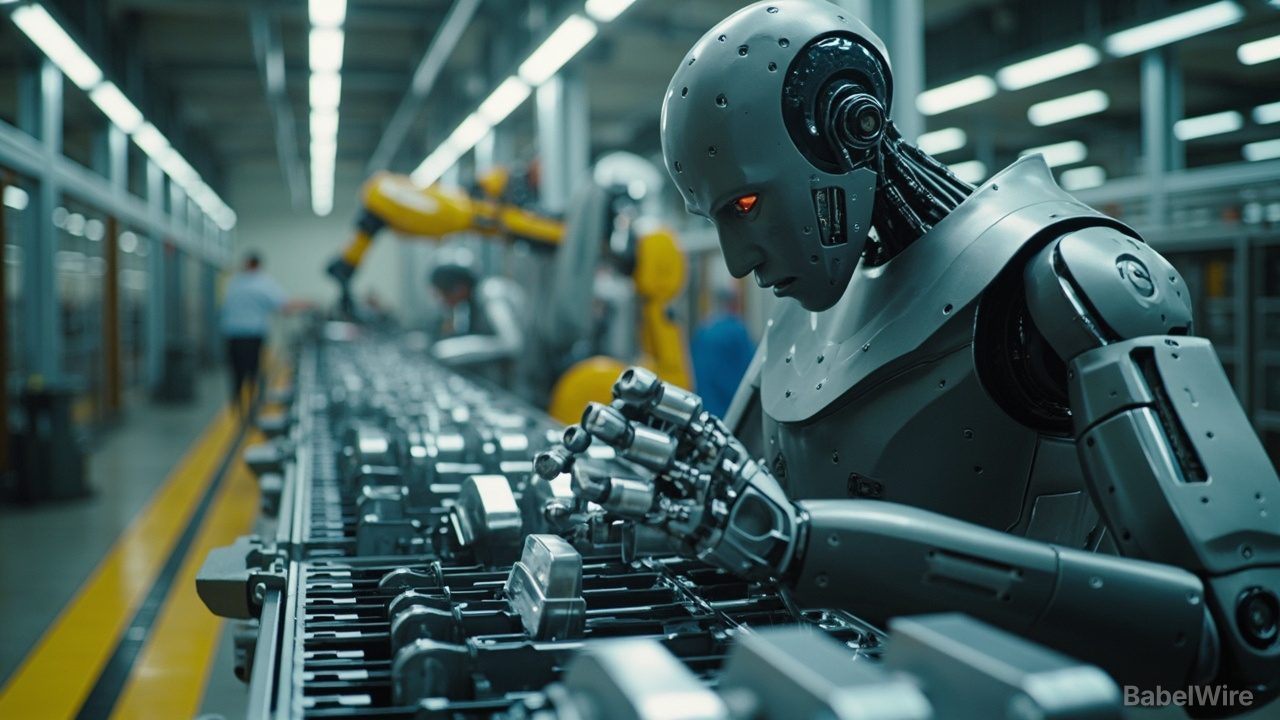
Google DeepMind introduced Gemini Robotics 2.5 on November 10, calling it its most capable vision-language-action (VLA) model yet. The model pairs an 'actions' component that controls a robot's hands and arms with Gemini Robotics ER, an embodied-reasoning model that tracks multi-step workflows.
The headline result is a real-world proof-of-concept on active Mercedes-Benz production lines in Kecskemét, Hungary, and Sindelfingen, Germany. There, Apptronik's Apollo 2 humanoid used Gemini Robotics 2.5 to perform 'automotive kitting' — pulling metal brackets from bulk bins and sorting them into sequencing trays in the exact order each vehicle on the line requires. DeepMind reports a 96% success rate, with the robot correcting for gaps as it goes.
Across more than 200 evaluated tasks — from serving food with tongs to tying a bow and pipetting liquid — DeepMind says the model achieved 30% to 100% higher success rates than previous baselines while finishing tasks 20% to 30% faster. Safety also improved: steering around physical hazards lifted safe completions by 33% around obstacles and 43% near people.
DeepMind credits much of the gain to Gemini 4 Argon, which acted as a simulation engine, generating thousands of synthetic practice runs and digital twins to accelerate training. It also released ASIMOV-Jailbreak, a robotics-specific benchmark, saying Argon resists 99.5% of jailbreak attempts versus 82% for the prior baseline.
Caveats: this is a proof-of-concept, not a full production deployment, and the 96% figure still leaves a meaningful error rate. DeepMind says closing the gap to near-perfect reliability is the next hurdle. The model is rolling out to robotics partners.
