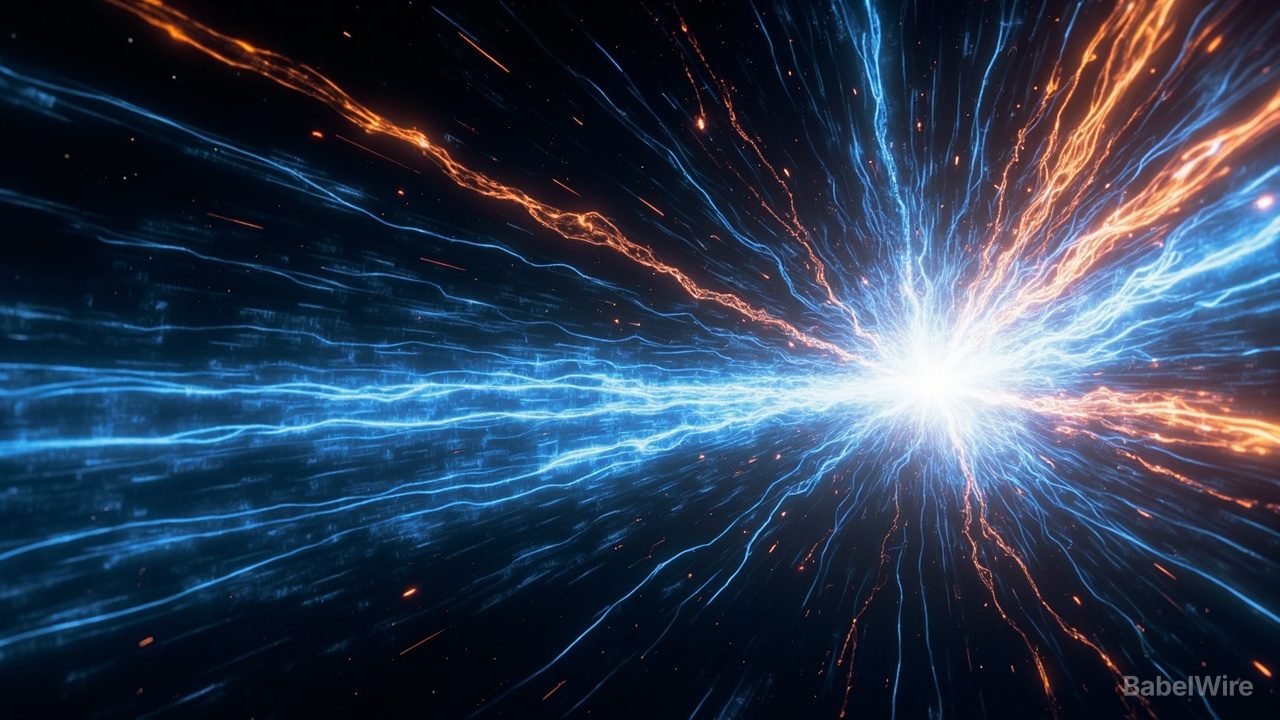
Laser-plasma accelerators can generate electric fields a thousand times stronger than conventional machines by making electrons surf on the wake of an intense laser pulse — but a nagging flaw has capped their energy: "dephasing." Electrons quickly catch up to the laser, which travels slightly slower than light in plasma, and fall out of the accelerating wave.
In a new Nature Physics study, an international team led by Charlie Arrowsmith at the University of Rochester's Laboratory for Laser Energetics used a "flying focus" to break that limit. Instead of a fixed focal point, the technique creates an extended focus whose peak intensity travels — and by tuning it to move at the vacuum speed of light, the accelerating electrons never outrun the wave.
On LLE's MTW-OPAL laser system, the team demonstrated dephasingless acceleration, boosting electrons to more than twice the energy the traditional limit would predict over the same distance. It is the first proof-of-concept that the long-standing ceiling can be crossed.
The implications are large. The technique could let a meter-long plasma produce 100-GeV electron beams — energies last achieved by CERN's 27-kilometer Large Electron-Positron Collider in the 1990s — and, further out, tabletop TeV-scale accelerators. Such machines could probe the breakdown of quantum electrodynamics in ultra-strong fields.
The team is already designing bespoke optics to match the flying focus's velocity perfectly to the electrons, a step toward scaling the idea up at NSF's planned OPAL facility. If it works, the particle accelerators of the future may be measured in meters rather than kilometers.
Sources
- phys.orgPhys.org: 'Flying focus' laser overcomes key limitation in plasma-based particle accelerators
- nature.comNature Physics: Dephasingless laser wakefield acceleration of electrons using a flying focus
- lle.rochester.eduLaboratory for Laser Energetics: Flying Focus Enables a New Regime of Laser-Plasma Acceleration