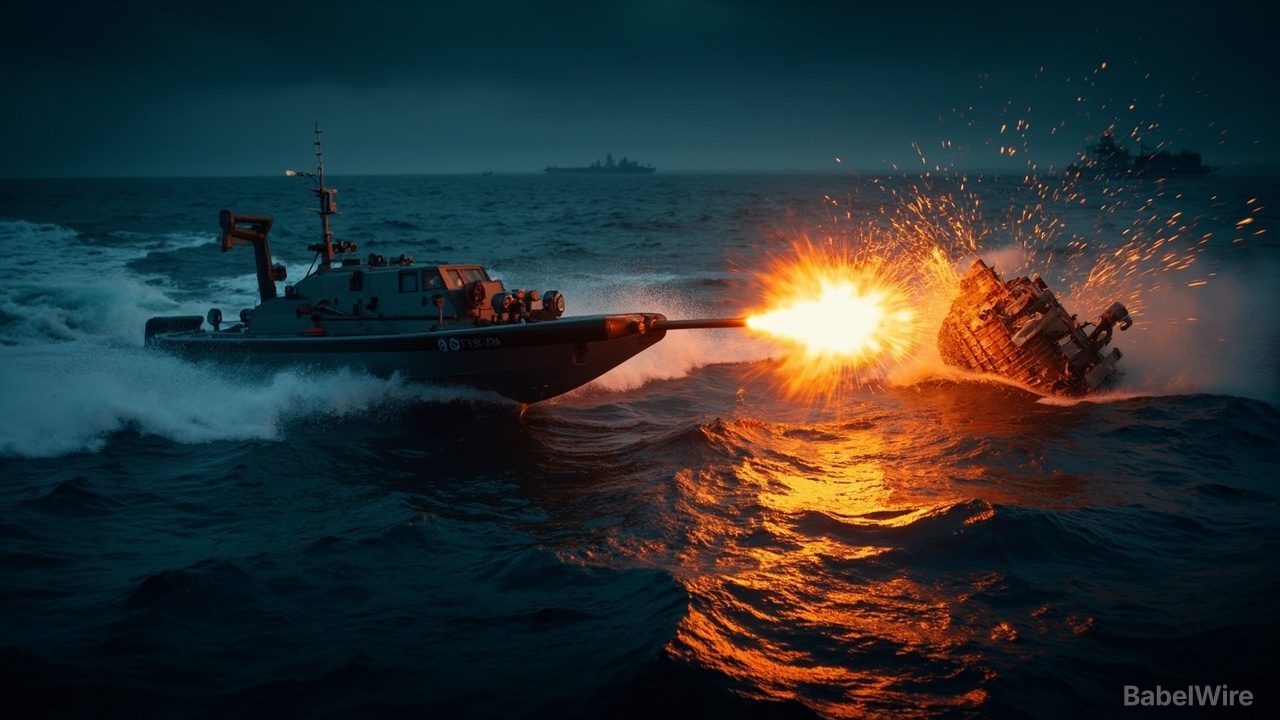
A Ukrainian navy Sargan-3000 unmanned surface vessel sank a Russian Orcan drone boat in the Black Sea on September 12, in what naval analysts are calling the world's first battle between unmanned warships.
The Engagement
Ukraine's Defense Intelligence Directorate spotted the target, and the navy dispatched a single Sargan-3000 fitted with a Kongsberg Protector remote weapon station mounting a 12.7mm heavy machine gun. An 81-second video released by the Ukrainian navy on X and Telegram shows the Sargan-3000 closing on the Russian drone, opening fire, and continuing to engage as debris flew from the Russian vessel's hull. The Orcan eventually sank stern-first.
The engagement most likely took place in the northwestern Black Sea between Odesa and the Crimean Peninsula, according to military analysts. The Russian drone was assessed to be an upgraded model in the Orcan series — suicide-attack craft typically loaded with explosives for strikes against Ukrainian ports and naval vessels.
The Sargan-3000
Named after the needle fish ("sargan" in Ukrainian), the vessel was formally adopted by the Ukrainian navy in April 2026 after being unveiled by President Volodymyr Zelenskyy. Originally designed as a kamikaze strike drone, it evolved into a multipurpose maritime platform.
Key specifications: - Length: 6.9 meters, Width: 2.2 meters - Speed: 40–55 knots (74–102 km/h) - Range: Up to 1,600 kilometers - Armament: Kongsberg Protector RWS with 12.7mm machine gun - Navigation: Autonomous inertial, optical, and GPS-denied capable - Network: Linked to Delta battlefield awareness system, Western commercial and NATO military satellite networks
Russian military publication AmalNews noted the Sargan-3000's success was partly due to its reduced radar signature, low hydrodynamic hull, and waterjet propulsion system.
Why It Matters
Previous naval drone operations in the Ukraine war focused on surprise kamikaze attacks against large, lightly defended warships — forcing Russia to withdraw its Black Sea Fleet from occupied Crimea to mainland bases. This engagement marks a tactical evolution: a drone boat directly destroying a fast-moving enemy unmanned vessel with a remote-controlled weapon.
The War Zone, a U.S. military publication, noted that engagements between unmanned surface vessels represent a significant development given the difficulty of detecting drones across vast ocean expanses. Long-range, long-endurance USVs could serve not only as offensive hunters of enemy drone boats but also as protective screens for high-value targets under attack.
Military experts described the event as the naval equivalent of aerial dogfighting — a form of combat that will inevitably reshape naval warfare doctrine. With both sides now deploying autonomous and semi-autonomous surface combatants, the Black Sea is becoming the proving ground for a new era of unmanned maritime conflict.
The operation continues Ukraine's broader campaign to deny Russia naval dominance in the Black Sea through asymmetric drone warfare, a strategy that has already sunk or damaged dozens of Russian warships since 2022.
Sources
- en.sedaily.comSeoul Economic Daily — Ukrainian Sea Drone Sinks Russian Counterpart in First Such Battle
- golem.deGolem.de — Kampf der Maschinen: Ukraine versenkt erstmals russische Seedrohne mit Seedrohne
- wsj.comWSJ — Ukraine Sea Drone Sinks Russian Ship Near Compound Said to Be Linked to Putin
- navalnews.comNaval News — Ukraine strikes Russian submarine with 'Sub Sea Baby' drone