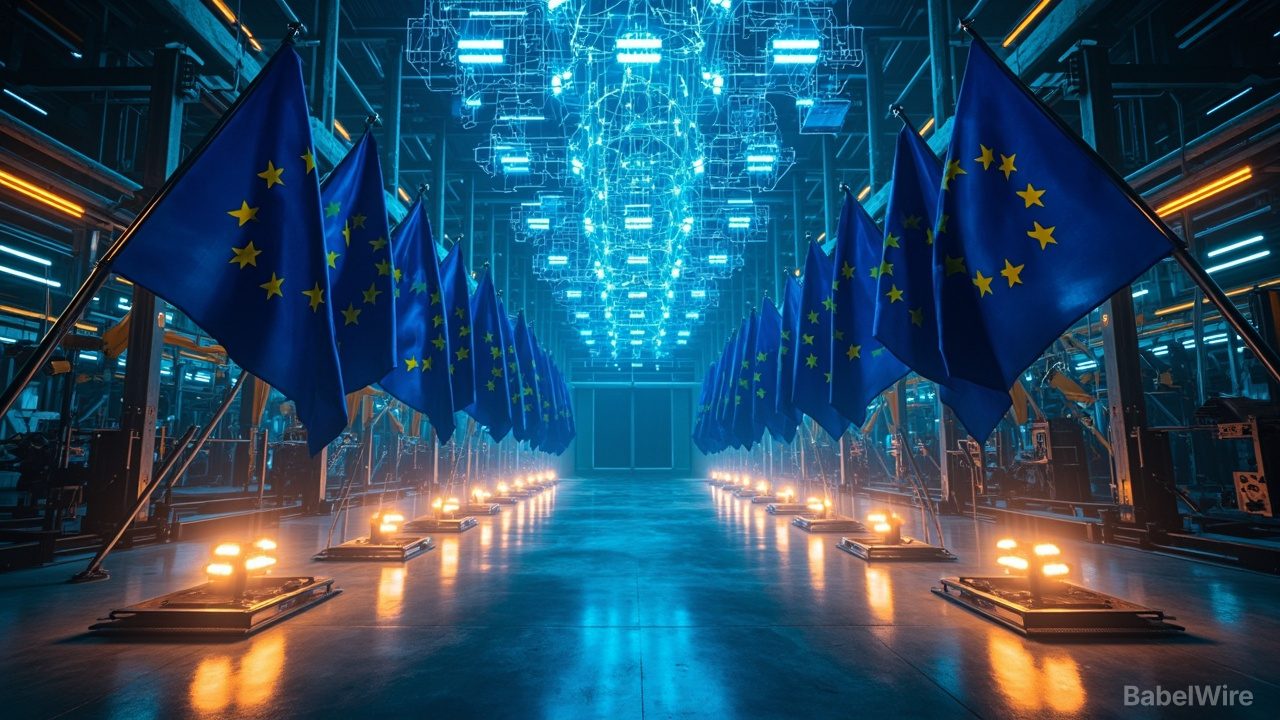
Nineteen EU countries have formally launched the most ambitious collective AI initiative Europe has attempted to date. At a signing ceremony on September 17, ministers and senior government representatives endorsed the manifesto for IPCEI-AI — an Important Project of Common European Interest for Artificial Intelligence — committing to a total investment exceeding €10 billion across more than 150 individually selected projects.
The initiative is coordinated at EU level by Germany's Federal Ministry for Economic Affairs and targets the entire AI value chain: from foundational research and development through to first industrial deployment. Unlike consumer-facing chatbots, IPCEI-AI is explicitly focused on the B2B and industrial sector — building a federated, distributed infrastructure for AI services that can serve Europe's manufacturing backbone.
Germany's Economic Affairs Minister Katherina Reiche highlighted Europe's core competitive advantage: while US and Chinese tech giants dominate the consumer AI market, European industry possesses vast quantities of high-quality process, machine, and production data. The project aims to convert this data depth into proprietary, market-ready AI technologies and viable business models.
The funding structure follows the established IPCEI model: projects are predominantly privately financed but co-financed by public funds, contingent on cross-border collaboration and positive multiplier effects across the EU single market. German project proposals were submitted to the European Commission in September for state aid review; if approved on schedule, the official project launch is planned for spring 2027.
The consortium covers a broad spectrum beyond core industrial AI: robotics, semiconductors, energy, healthcare, telecommunications, agriculture, and public administration are all expected to benefit from the new core models and agent frameworks being developed. The initiative complements existing European mega-projects focused on cloud infrastructure and microelectronics.
The sheer scale — 19 countries, 150+ projects, €10+ billion — signals that Europe is no longer content to be a regulatory bystander in the global AI race. Whether execution can match the ambition, however, will depend on the speed of state aid approval, the ability to coordinate across nearly two dozen national regulatory frameworks, and whether the promised private-sector co-investment materializes at the projected levels.