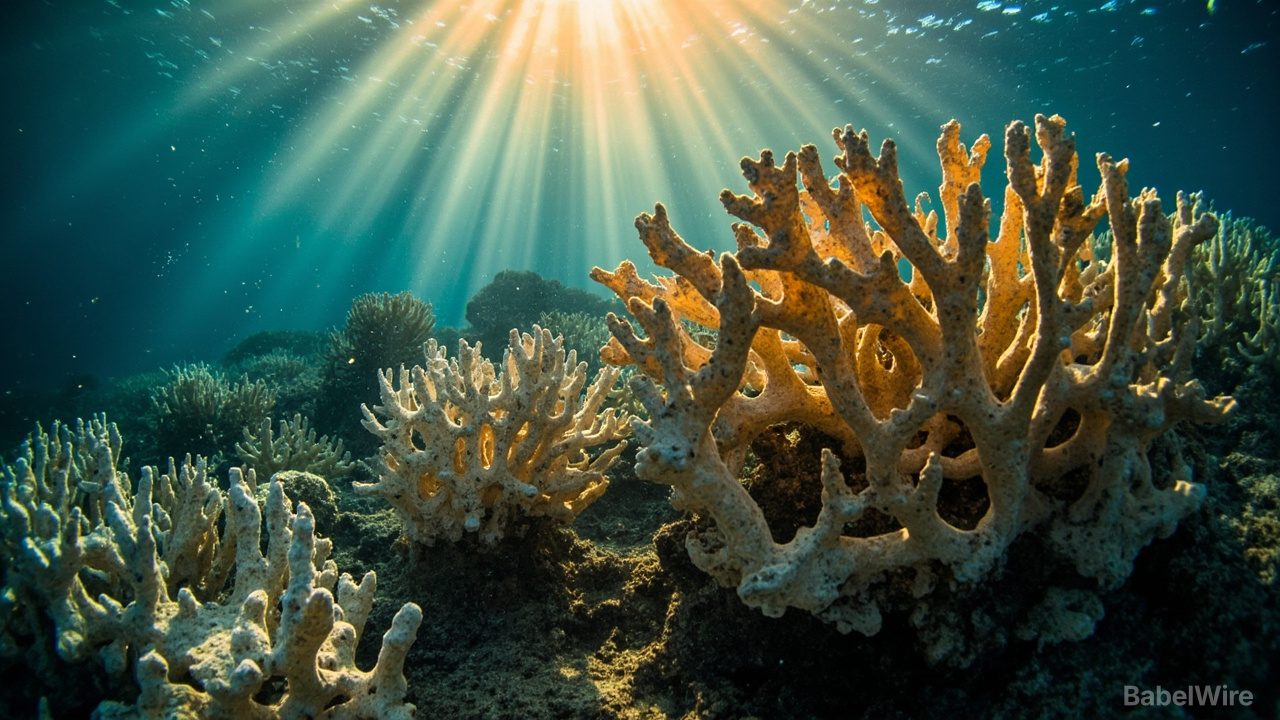
A landmark study published Thursday in Science reveals that El Niño events over the past 40 years have become 36% stronger than those before the industrial revolution — and about 16% stronger than 20th-century events — using a novel technique that extracts climate history from the chemistry of ancient and living coral skeletons.
The research, led by Julia Cole of the University of Michigan, analyzed coral core samples from the Galápagos Islands, a critical region in the eastern tropical Pacific where El Niño intensifies. By measuring isotope ratios preserved in coral skeletons, the team constructed a 1,000-year record of El Niño variability that serves as a baseline for detecting human-caused shifts.
"Something is going on now that is highly unusual and very likely due to human-caused climate change," said co-author Jonathan Overpeck, dean of the University of Michigan's School for Environment and Sustainability.
The findings come at a critical moment: a developing Super El Niño is gathering strength in the tropical Pacific, forecast to become the strongest such event since at least 1950. NOAA forecasts show a greater than 90% chance of a very strong El Niño during fall and winter 2026-27, raising fears of a fifth global coral bleaching event.
The study used 12 state-of-the-art climate models to rule out natural variability as the cause of intensification, leaving human-caused global warming as the most likely explanation. The swings from El Niño to La Niña are increasing in amplitude, driven by increasingly intense El Niño phases.
The research highlights an urgent conservation paradox: the very corals providing these insights are themselves threatened by the warming waters they helped reveal. Scientists are racing to collect coral samples before healthy corals disappear — a pursuit likened to glaciologists securing ice cores from rapidly receding mountain glaciers.