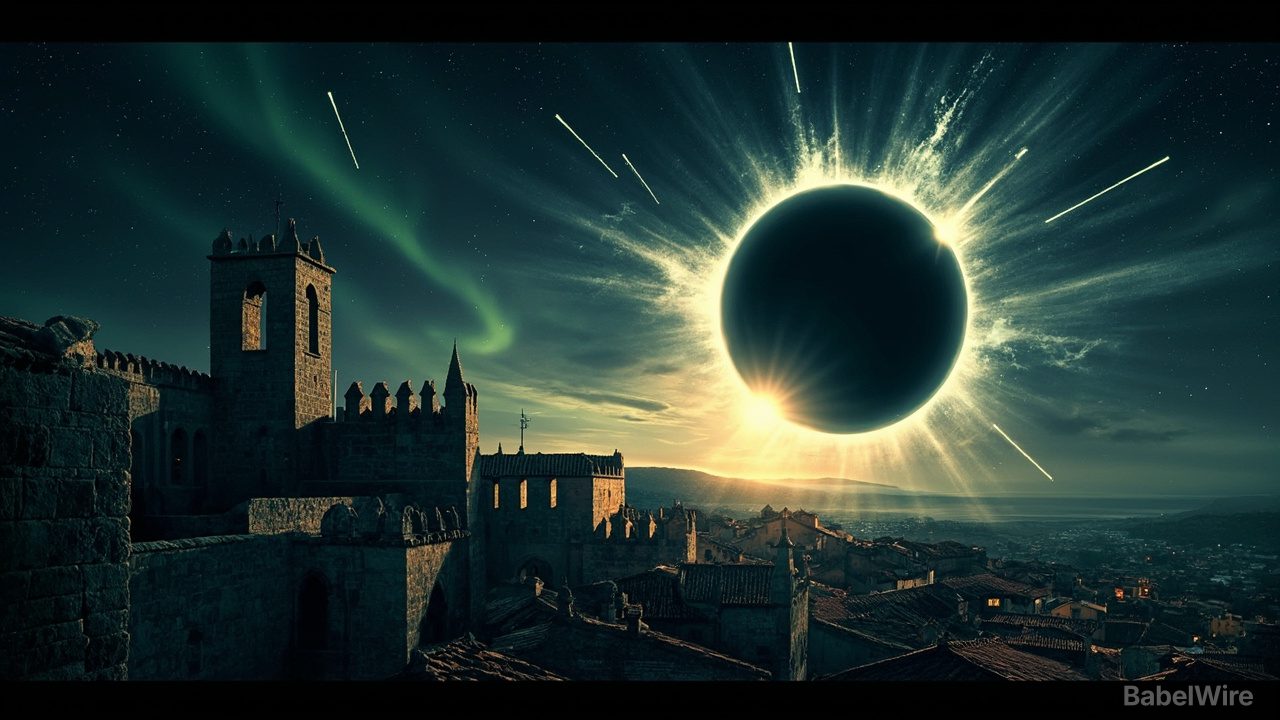
Skywatchers have been counting down for months, and the day has finally arrived: on Wednesday, August 12, 2026, a total solar eclipse sweeps across the Arctic, Greenland, Iceland and northern Spain — and it is sharing the sky with a solar storm, a meteor-shower peak and a torrent of online misinformation.
The Moon's shadow races across northern Russia, the Arctic Ocean, Greenland, Iceland, the Atlantic, northern Spain and the far northeastern corner of Portugal, treating those in the path of totality to up to two and a half minutes of darkness. For most observers totality lasts under two minutes: in Reykjavík it runs from 5:48 to 5:49 p.m., in León, Spain from 8:28 to 8:30 p.m. Much of the Northern Hemisphere — from Alaska to North Carolina, across Canada, Europe and northwestern Africa — sees a partial eclipse. Madrid, Paris, London and Berlin will see roughly 99%, 92%, 91% and 85% of the Sun covered, respectively.
Adding to the spectacle, NOAA forecast models predict a coronal mass ejection will hit Earth's magnetic field today, potentially triggering G1 or G2 geomagnetic storms and auroras at high latitudes — just as the Perseid meteor shower peaks on the night of August 12–13.
NASA urges safe viewing: proper eclipse glasses (ISO 12312-2) — never regular sunglasses — or indirect pinhole projection. The agency streams the eclipse live starting at 1:15 p.m. EDT. And no, Earth will not lose gravity for seven seconds: NASA has had to debunk the viral 'Project Anchor' claim, which falsely tied a gravity 'blackout' to today's eclipse.