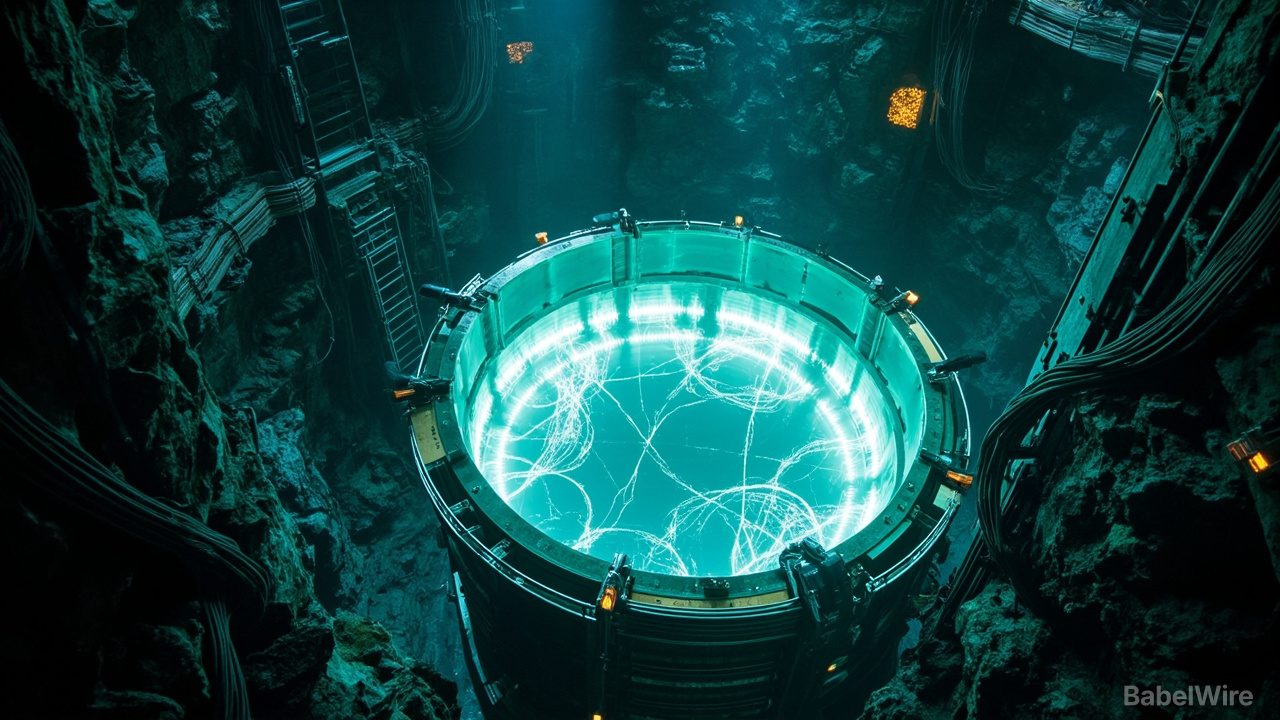
Nuclear reactors may go dark, but their story does not end. Long-lived fission products keep decaying for months or even years after a reactor is switched off, releasing a faint stream of antineutrinos — the lightest and most elusive known particles, which escape from the reactor and its shielding unhindered. For the first time, researchers have measured this residual 'ghostly afterglow.'
The Double Chooz collaboration, led by scientists at the Max Planck Institute for Nuclear Physics (MPIK) in Heidelberg, reports the result in Physical Review Letters. The team analyzed 17.2 days of data recorded while both reactor units at the Chooz nuclear power plant in northern France were completely shut down. Their underground detector, located about 400 meters from the two cores and containing more than 30 cubic meters of liquid scintillator, registered around 100 antineutrino candidate events originating from residual radioactivity in the cores and in nearby spent-fuel cooling pools.
When an antineutrino interacts inside the detector, it produces a characteristic double-light signal that can be distinguished from background — the signature that let the researchers identify the reactor antineutrinos. The measured signal agrees remarkably well with detailed simulations of the remaining fuel inventory and the decay of long-lived fission products, making this the first direct experimental validation of predictions for antineutrino emission from shutdown reactors and spent fuel.
The result opens new perspectives: antineutrino detectors could verify reactor status and spent-fuel inventories during maintenance periods and after shutdown, complementing international safeguards efforts. Recent first results from JUNO-TAO, presented at Neutrino 2026, show other experiments are already moving in the same direction. Double Chooz, originally built to study neutrino oscillations and a key player in measuring the mixing angle θ13, has now achieved another first: seeing the faint glow left behind when a reactor goes dark.