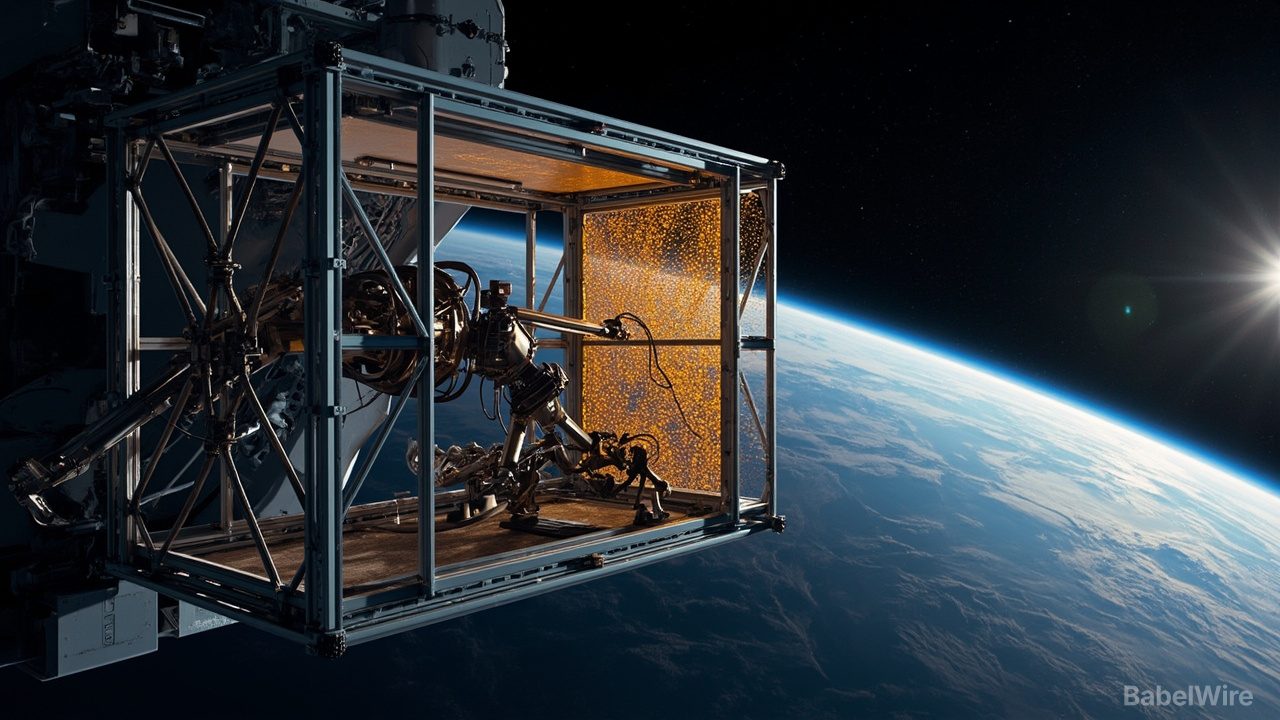
For the first time, a machine built a structure in space without an astronaut touching it. On November 5, DARPA said a Caltech payload in orbit had assembled a truss from individual parts — the end of a demonstration that started as a ground test and became a flying prototype in 15 months.
The system is called ASTRA, for Autonomous In-Space Tensioned Reflector Assembly. It is a gantry robot moving along three linear axes, picking composite struts and aluminium joints out of motorised dispensers and building identical sections — bays — of a perimeter truss on an assembly plate. It then lays down a thin perforated Kapton film that becomes two cable nets prestressed against each other by springs. Finished bays are pushed out and the next one begins.
Eleven bays would have made a reflector 1.4 metres across. The team built the third. The mission window did not allow more; ASTRA ends in December. Caltech says so plainly: time limits and a series of unforeseen problems in orbit prevented the full build. What survives is proof that the sequence works — and that it scales.
The payload launched on March 30, 2026, aboard SpaceX's Transporter-16 from Vandenberg Space Force Base, as one of ten payloads on Momentus's Vigoride 7 orbital vehicle. It is roughly one cubic metre, carried two prebuilt bays, the manipulator and every part needed for the rest. Contact with the ground came in short windows of about 15 minutes, seven or eight times a day. When something went wrong, the team reproduced the fault on a flight spare in the lab in Pasadena and sent the workaround up.
Why this is more than a lab stunt is launch physics. Large structures today are either folded into a fairing and unfurled — which caps their size — or sent up in pieces and assembled by astronauts, as on the ISS. DARPA's NOM4D programme, started in 2022, is chasing a third option: fly up material and parts, and build where the structure is needed.
Programme manager Andrew Detor is blunt about the target scale: 'Hundreds of metres or kilometres. Nothing approaching that scale can be achieved today.' The candidates are large radio antennas, solar arrays for space-based solar power, depots and habitats — or modular data centres in orbit. Detor describes the Caltech approach as deliberately unglamorous: 'There are no complicated robotics or advanced algorithms; it's just solid engineering.'
The film is the real engineering. The perforated material, co-invented with Igor Bargatin's group at the University of Pennsylvania, needs less prestress than the knitted metallic mesh normally used in furlable reflectors, which allows much lighter structures.
To be clear about the size of the claim: this is the first section of a truss, not a working antenna. Structural performance, dimensional stability across many bays and full-scale manufacturing are unmeasured — they are the next step. NOM4D has one milestone left: the University of Illinois Urbana-Champaign will use an ISS module later this year to test a space-compatible resin system that cures into high-strength composite in orbit.
The pace is arguably the story. Caltech delivered the payload to Momentus in under twelve months; DARPA says 15 months passed from the idea of an orbital demo to launching a working prototype. 'Operating in space is much harder than operating on the ground — there's virtually no margin to address issues that may arise,' Detor said. 'Testing in the operational environment is instrumental to rapidly maturing the technology.'
Whether the proof of concept becomes an industry depends on the question Detor asks himself: 'Now that we've demonstrated a process that can scale to large structures, what do we go make?'