A tiny UK-developed satellite, roughly the size of a small carry-on suitcase, could help answer one of the biggest questions in cosmology: what happened during the roughly 150 million years of cosmic 'dark ages' before the universe's first stars appeared?
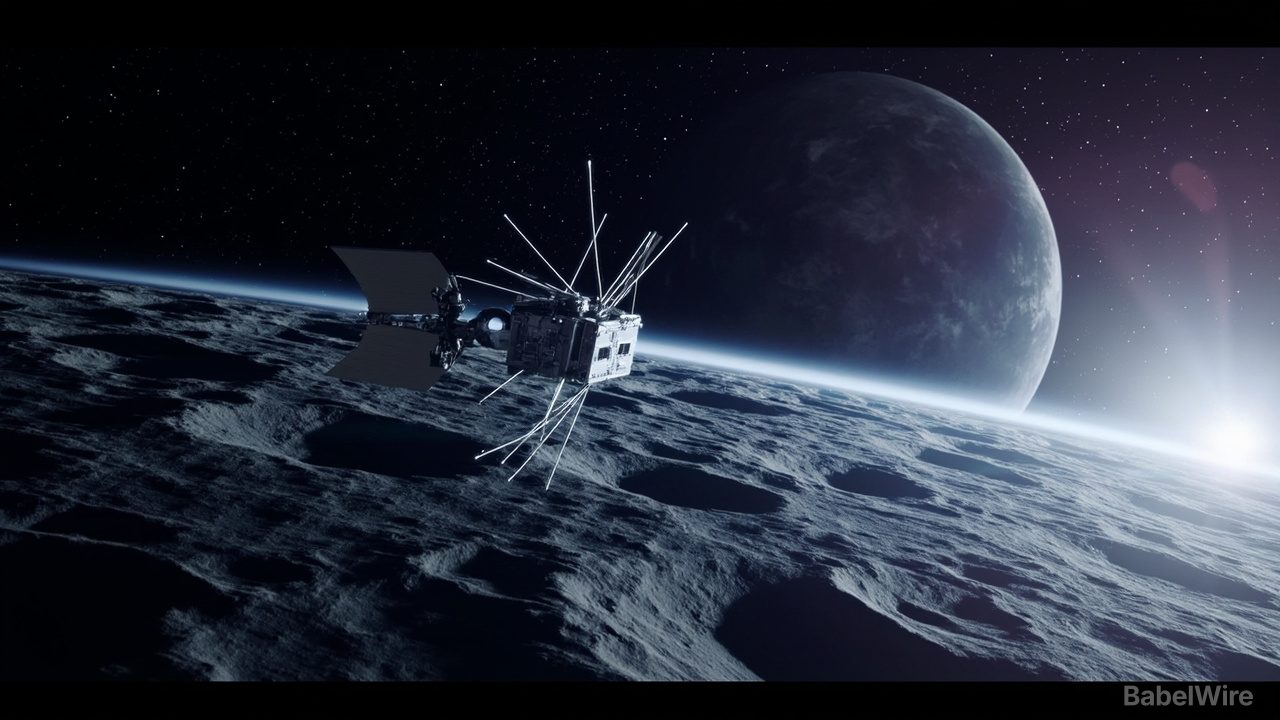
An international team of scientists led by the University of Cambridge plans to use the dark side of the Moon as a shield so that the satellite — called CosmoCube — can block out all the noise from Earth and listen for a faint whisper from the very early universe. That whisper is the 21-centimeter line, a signal emitted by hydrogen atoms in the period between the afterglow of the Big Bang and Cosmic Dawn, when nuclear fusion lit up the first stars. No one has directly observed this era before.
Detecting a signal from more than 13.5 billion years ago is extremely difficult with Earth-based telescopes: the ionosphere blocks the relevant frequencies, and FM radio, satellites and telecommunications drown it out. The Moon provides a natural shield. As CosmoCube orbits the far side of the Moon, it is shielded from Earth's noise for roughly 40 minutes of each two-hour orbit. Over a planned two-year mission it would build up about 1,000 hours of data on one of the last unexplored periods of the universe.
The mission, funded by the UK Space Agency, would also explore the role of dark matter. 'This emission from hydrogen after the Big Bang, but before the first stars, will hopefully allow us to understand the role of dark matter in the early universe, how it worked to pull together hydrogen into the first stars and galaxies,' said lead author Professor Eloy de Lera Acedo of Cambridge's Cavendish Laboratory.
CosmoCube will operate at extremely low frequencies — between 10 and 50 MHz — far outside the reach of ground-based telescopes, unfolding a long, lightweight radio antenna once in lunar orbit. It will use a Dicke-switched calibrator to cancel out internal drift, and Bayesian methods back on Earth to strip foreground noise from our own galaxy. The platform, named SSTL-21, is being developed in the UK by Surrey Satellite Technology Limited, with academic partners including the University of Portsmouth and STFC RAL Space.
The researchers hope CosmoCube can launch within the next five years; the team recently responded to the ESA mini-Fast missions call for ideas, targeting a mission cost of under €50 million. Details appear in Nature Astronomy. 'Aside from the science, what makes our mission unique is its size: we're probing the earliest, deepest parts of the dark ages that others don't reach, but with a compact, relatively low-cost platform,' de Lera Acedo said.
Sources
- cam.ac.ukUniversity of Cambridge: Tiny satellite will use the dark side of the Moon to eavesdrop on whispers from the early universe
- theguardian.comThe Guardian: Scientists hope to shed light on young universe by using dark side of the moon
- phys.orgPhys.org: Tiny satellite will use the dark side of the moon to eavesdrop on whispers from the early universe