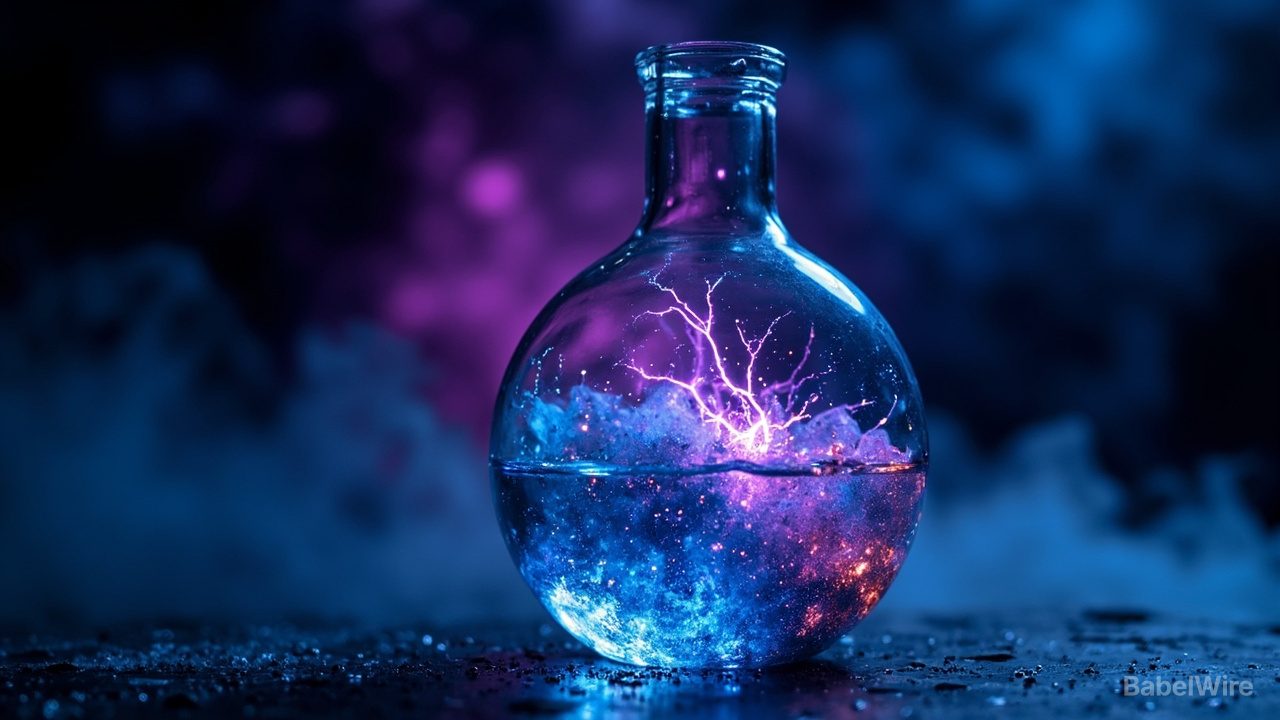
A PhD student in Sydney has produced cosmic dust from scratch by recreating a small piece of the universe inside a laboratory bottle, offering new clues about how life's chemical ingredients may have developed before Earth even formed.
Linda Losurdo, a PhD candidate in materials and plasma physics at the University of Sydney, combined nitrogen, carbon dioxide, and acetylene to simulate the energetic conditions found near stars and supernova remnants. She then exposed the gases to a powerful electrical charge of around 10,000 volts, creating a glow discharge plasma.
The process created carbon-rich dust containing complex combinations of carbon, hydrogen, oxygen, and nitrogen — known as CHON molecules, which are considered important for life.
"We no longer have to wait for an asteroid or comet to come to Earth to understand their histories," Losurdo said. "You can build analogue environments in the laboratory and reverse engineer their structure using the infrared fingerprints."
In space, cosmic dust develops under extreme conditions where molecules are repeatedly struck by ions and electrons, triggering chemical reactions that create increasingly complex materials. Losurdo's laboratory samples produced the same distinctive infrared signatures seen in space, indicating the experiment closely reproduces real cosmic processes.
How life began on Earth remains one of science's greatest unanswered questions. From about 4.56 billion to 3.5 billion years ago, meteorites, micrometeorites, and interplanetary dust repeatedly struck Earth, carrying enormous quantities of organic material to the surface.
The research could help clarify where that material originally formed and which processes created it.
The team plans to assemble a detailed database of infrared fingerprints produced by different types of laboratory-made cosmic dust. Astronomers could compare those signatures with observations of star-forming regions and the remains of dead stars to identify where certain forms of dust are produced.
"By making cosmic dust in the lab, we can explore the intensity of ion impacts and temperatures involved when dust forms in space," said Professor David McKenzie, coauthor of the study. "That's important if you want to understand the environments inside cosmic dust clouds, where life-relevant chemistry is thought to be happening."
The findings were published in The Astrophysical Journal of the American Astronomical Society.