What Happened
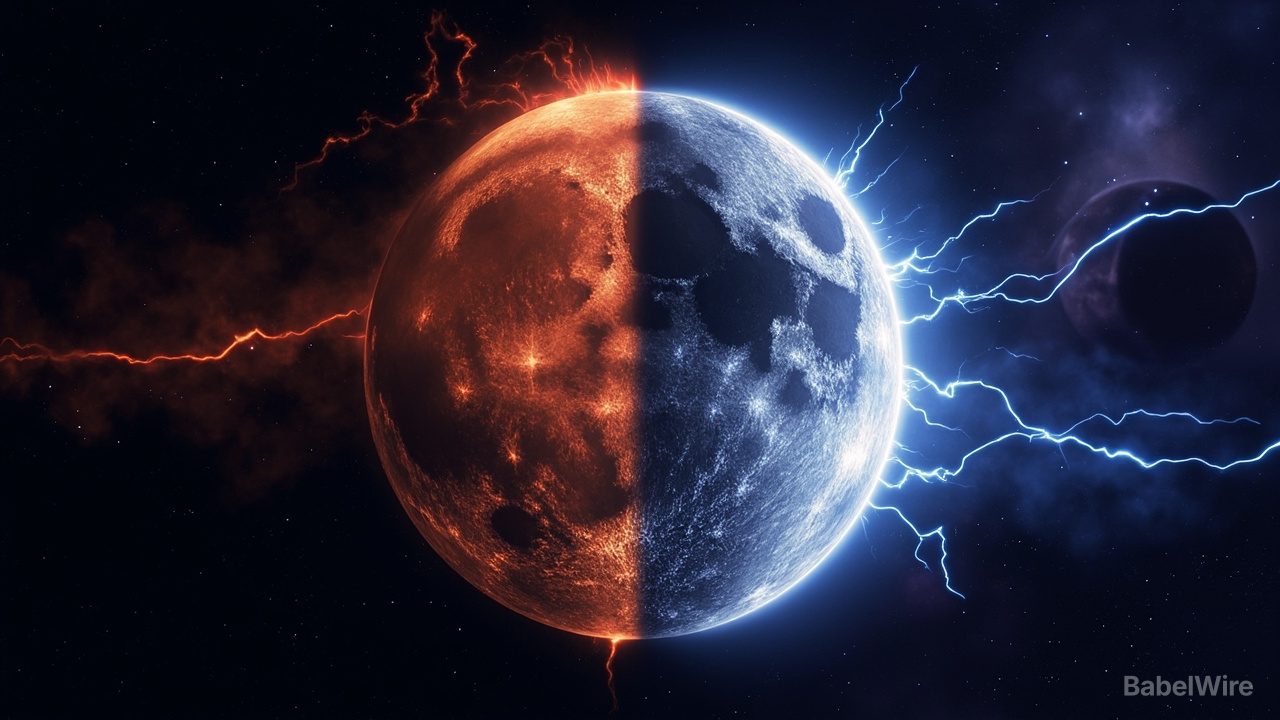
A groundbreaking study of lunar samples returned by China's Chang'e-6 mission has revealed a surprising 4-billion-year-old secret: Earth's magnetosphere has been shielding the Moon's near side from the full force of the solar wind, while the far side bears the brunt of high-energy particles.
The research, published in Nature Geoscience in July 2026, analyzed noble gases — helium, neon, argon, krypton, and xenon — preserved in lunar regolith from both the near side (Chang'e-5 samples) and far side (Chang'e-6 samples).
Key Findings
Deeper penetration on the far side: Solar wind ions penetrated significantly deeper into far-side regolith than into near-side soil, indicating the far side was exposed to higher-energy particles.
Distinct isotope signatures: The neon isotope ratio (²⁰Ne/²²Ne) in Chang'e-6 samples was substantially lower than in all previously analyzed near-side samples — close to the theoretical value expected after strong solar wind fractionation.
Release patterns differ: Xenon in Chang'e-6 samples released at high temperatures only (single peak), while Chang'e-5 samples showed a double-peaked pattern — further evidence that far-side particles hit harder and burrowed deeper.
The Mechanism: Earth's Magnetic Shield
The research team, led by the Institute of Geology and Geophysics of the Chinese Academy of Sciences, attributes this hemispheric difference to Earth's magnetosphere. As the Moon orbits Earth, it passes through the magnetosheath — a buffer zone where solar wind slows from its typical 400 km/s to about 200 km/s.
This slower wind primarily reaches the lunar near side. The far side, facing away from Earth, remains exposed to undisturbed, high-speed solar wind.
The researchers estimate that about 25% of total solar wind exposure at the Chang'e-5 landing site was influenced by decelerated wind, while the Chang'e-6 site experienced none.
Why It Matters
This is the first direct empirical evidence from far-side samples confirming Earth's magnetosphere shapes how solar wind hits the Moon. The findings reveal that heavy noble gases in lunar soil serve as "fossil records" of past Sun-Earth-Moon interactions, offering a new method for reconstructing the long-term evolution of Earth's magnetosphere over billions of years.
"Interactions within the Sun–Earth–Moon system are more complex than previously recognized," the researchers said. Earth's nearest celestial neighbor has been quietly preserving records of these ancient dynamics in its soil — and now, for the first time, we can read them.
Sources
- english.cas.cnChinese Academy of Sciences — Chang'e-6 Samples Reveal How Earth Slows Solar Wind
- nature.comNature Geoscience — Deeper solar wind penetration on the Moon's farside from noble gas records
- sciencedaily.comScienceDaily — China's Chang'e-6 reveals why solar wind hits the Moon's farside harder