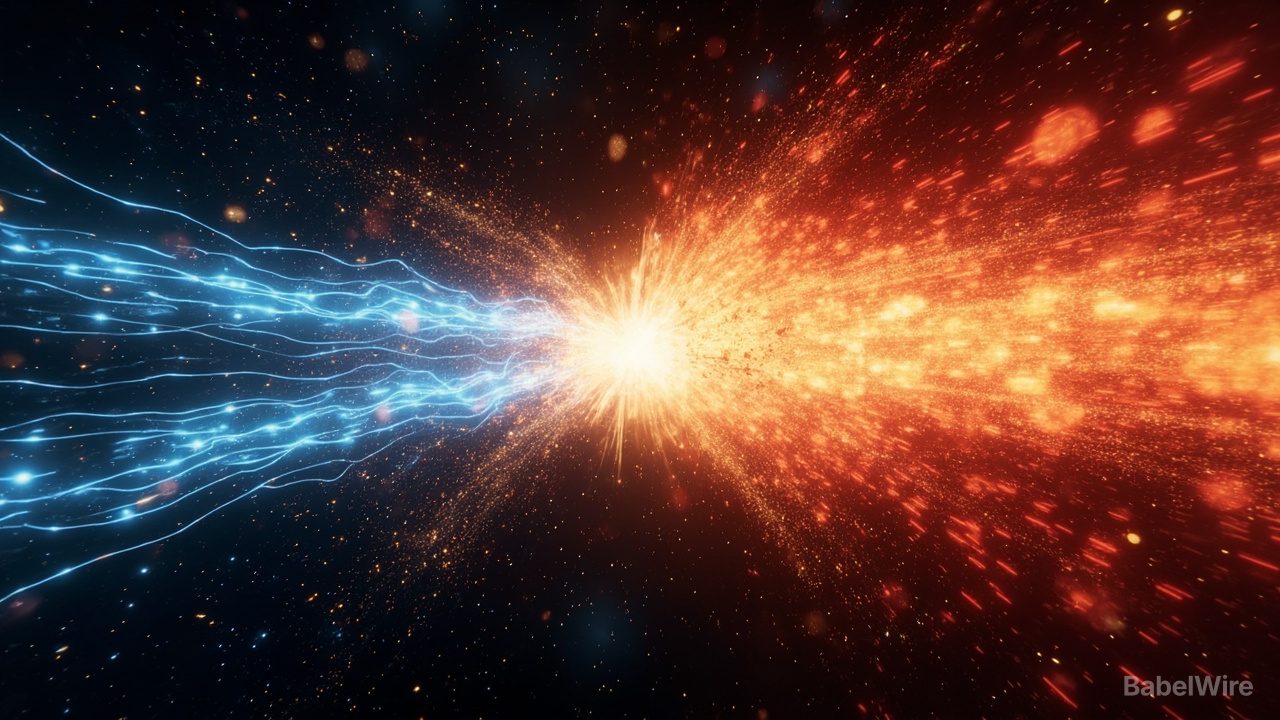
One of the greatest mysteries in physics is why our Universe is made almost entirely of matter. The Big Bang should have produced matter and antimatter in nearly equal amounts — yet today, almost no antimatter remains. The CMS Collaboration at CERN has just taken the largest-ever step toward understanding why.
Using its largest sample of beauty mesons to date, collected from proton-proton collisions at the Large Hadron Collider between 2022 and 2025, the CMS team performed a high-precision test of charge-parity (CP) violation — the subtle difference in behavior between matter and antimatter that may explain our matter-dominated Universe.
How beauty mesons reveal the asymmetry
Neutral beauty mesons have a remarkable property: they can spontaneously transform into their own antiparticles and back again. By measuring the tiny difference in how often matter and antimatter versions of these particles decay over time, physicists can test the Standard Model's predictions with unprecedented precision.
The CMS Collaboration reconstructed specific decays of about 1.4 million B0 mesons (containing a down quark) and 16,000 B0s mesons (containing a strange quark). A key challenge was determining the type of each meson at the moment it was produced, before it decayed into a J/ψ meson and a neutral kaon.
AI-powered particle physics
To achieve this, CMS employed a state-of-the-art artificial intelligence algorithm that combines information from muons, electrons, jets associated with a collision event, and — for the B0s meson — nearby particles produced in the collision. This significantly improved the experiment's ability to identify the meson's initial state compared to previous analyses.
The measured CP violation is in line with the predictions of the Standard Model and includes the most precise measurement to date of CP violation in the decay of a B0s particle into a J/ψ meson and a neutral kaon. The accompanying study of the B0 decay provides an important cross-check of the same underlying physics.
What's next
As the LHC delivers ever-larger datasets during the upcoming High-Luminosity LHC era, measurements of CP violation like these will become even more precise. Whether they continue to confirm the Standard Model or uncover subtle deviations from predictions, they will deepen our understanding of why our Universe is made of something rather than nothing.
The results place tight constraints on possible contributions from new particles beyond those predicted by the Standard Model — narrowing the search for the fundamental forces that shaped the cosmos.