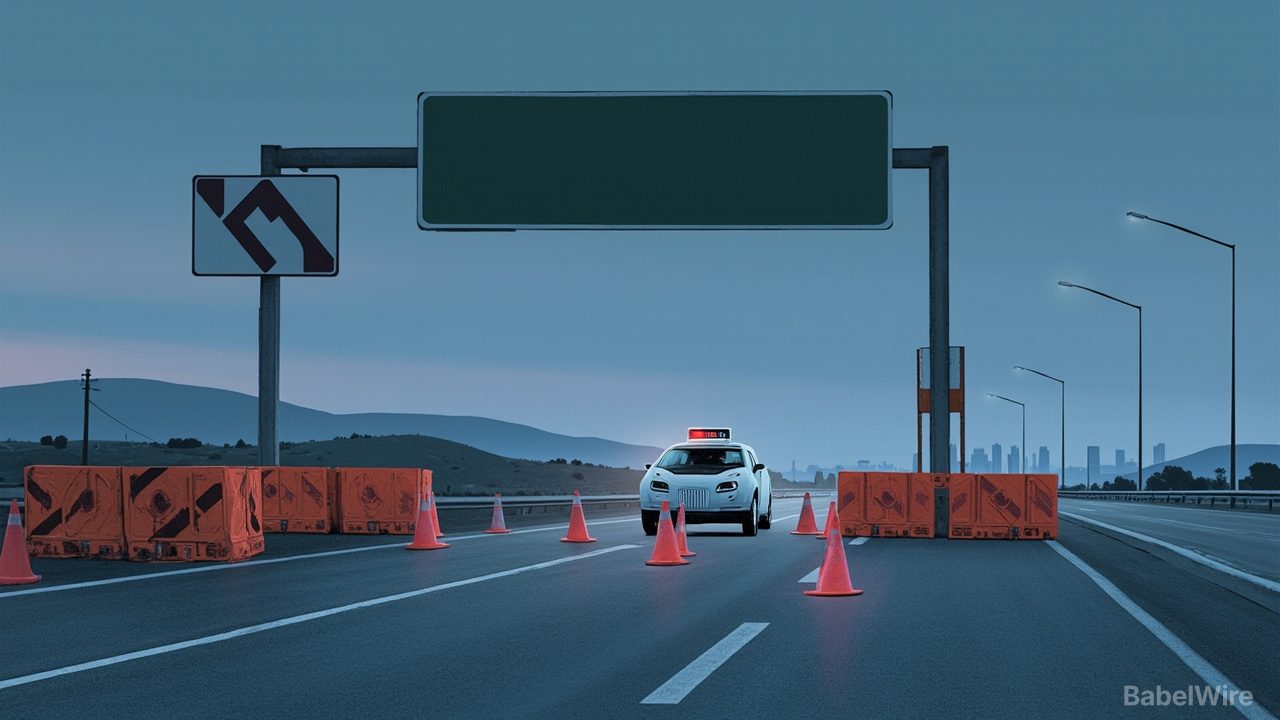
California's Department of Motor Vehicles has banned Waymo's self-driving cars from the state's freeways, The Verge reports, with the regulator pointing at safety concerns in construction zones.
The order covers all state freeways, not only the stretches where work is under way right now. That distinction matters: freeways are how a robotaxi service crosses a sprawling metropolitan area quickly, so losing them reshapes routing for every trip that would otherwise have started on a highway on-ramp.
For Waymo, owned by Alphabet, California is one of its most important markets, which gives the restriction consequences well beyond any single work site. It also hands other states a template — if construction-zone behavior at freeway speeds is treated as disqualifying, the same argument can be made anywhere roadwork happens.
Construction zones are a genuinely hard environment. Lane lines shift or vanish, signage is temporary, arrow boards and flaggers direct traffic, and workers stand beside live lanes. Conditions change daily, and there is no national standard for how a work zone must be marked, which is exactly what makes them hard to validate for a system that has to generalize rather than memorize.
The ban does not stop Waymo from operating in California; its cars remain on surface streets. What it removes is the high-speed layer of the network, pushing the service toward slower, shorter runs.
The decision arrives as autonomous vehicle operators expand into more cities and state legislatures write their first dedicated rules for them. How a large regulator settles the construction-zone question is likely to travel.