More than 100 years ago, psychologist Wolfgang Köhler famously showed that chimpanzees could solve novel problems by combining objects in new ways, such as stacking boxes to reach an out-of-reach banana. Now, researchers from Finland report strikingly similar abilities in bumble bees.
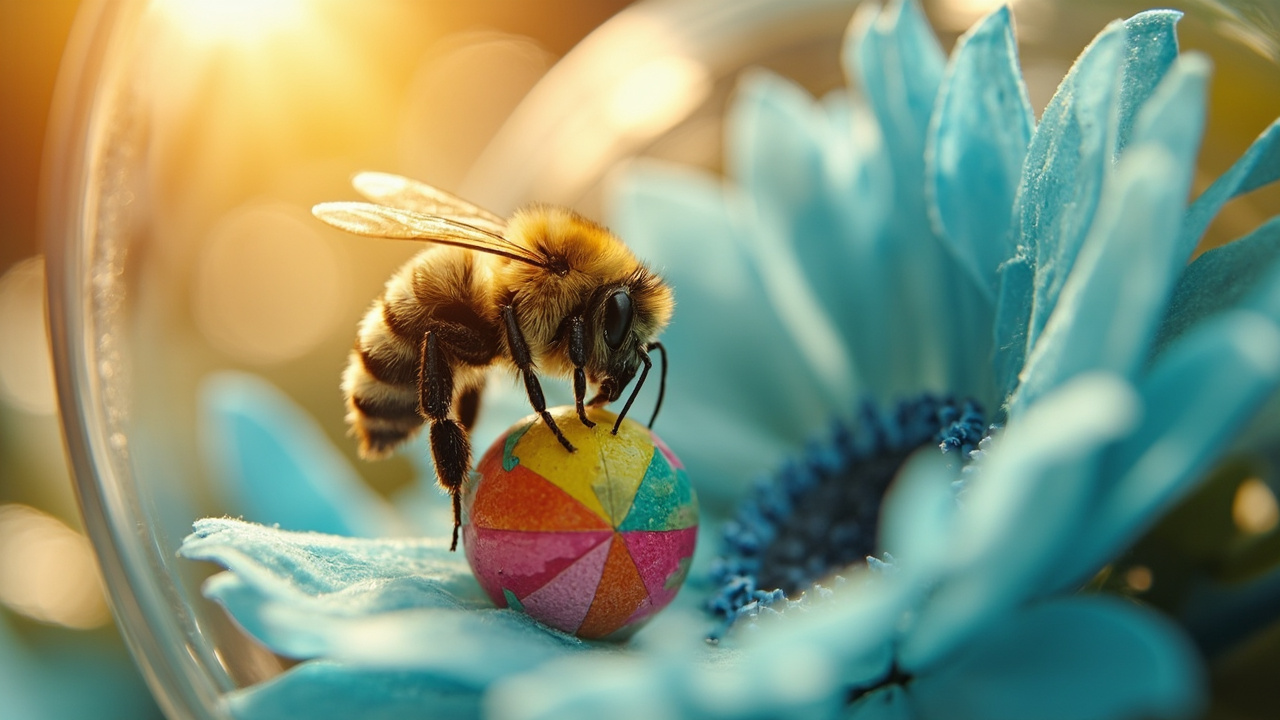
Published in the journal Science, the study shows that bumble bees (Bombus terrestris) spontaneously solved a completely novel object-manipulation task. The bees first learned that a blue artificial flower signaled reward. During the test, the flower was moved to the ceiling of a transparent arena, out of reach. To access it, the bees spontaneously generated a novel solution: moving a ball underneath the flower and climbing onto it — a sequence they had never been trained to perform.
"This is essentially an insect version of the classic 'box-and-banana' problem," says senior author Olli Loukola from the University of Oulu. "What stands out is that this kind of spontaneous problem-solving is now demonstrated in an insect."
The researchers designed several control experiments to rule out simpler explanations. In the most demanding tasks, the flower was hidden from the bees while they moved the ball, preventing them from steering toward a visible target. Even then, bees moved the ball correctly.
The study builds on growing evidence that bees possess sophisticated cognitive abilities despite tiny brains. However, the researchers do not claim human-like reasoning. "Miniature brains can generate flexible solutions to novel problems in ways we are only beginning to understand," says Loukola.