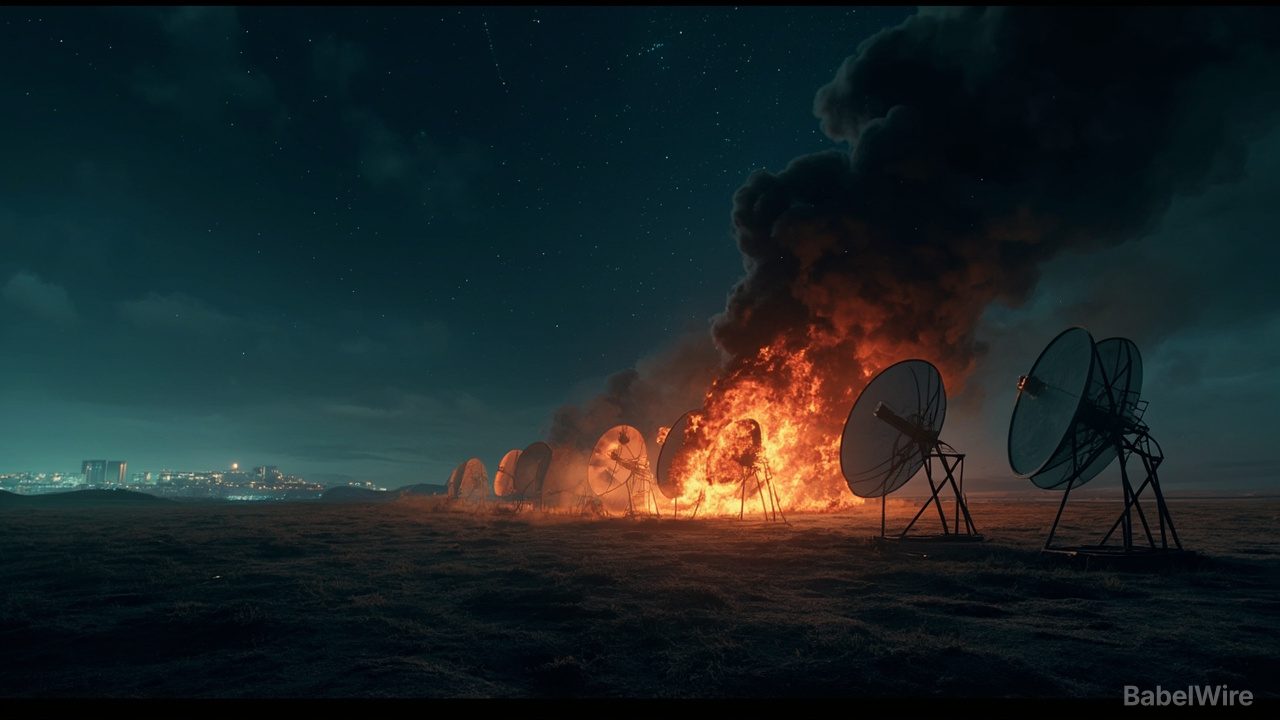
An arson attack has struck Starlink satellite-internet antennas in the area around Sofia, Bulgaria. The German technology outlet Golem reported the incident under the headline "Brandanschlag auf Starlink-Antennen bei Sofia" — an arson attack on Starlink antennas near Sofia.
Note on sourcing: only the report's headline and URL were retrievable for this brief, because the web-reading tool used to gather sources failed during this run. The account below separates what that report states from the wider context. The identity of those responsible, a stated motive and the full extent of the damage are not established in the available material, and this brief does not assert them.
WHAT THE HARDWARE IS
A Starlink user terminal is a flat, electronically steered phased-array dish paired with a small router. It connects the user directly to SpaceX's low-Earth-orbit broadband constellation, bypassing terrestrial fibre and mobile networks. Because the dishes are consumer hardware that can be ordered and shipped almost anywhere, they double as one of the most visible physical artefacts of the constellation's expansion.
WHY THE EQUIPMENT GETS TARGETED
That visibility is the problem. Starlink access has been a recurring political flashpoint since the start of Russia's full-scale invasion of Ukraine, where the terminals kept front-line and blackout-hit areas online. The very property that makes the service useful in a war zone — staying online when ground infrastructure fails — also makes the hardware a symbol worth attacking.
Bulgaria is a NATO and European Union member on the Black Sea, a region where the security of communications infrastructure has been a standing concern. Deliberate attacks on communications hardware — mobile masts, undersea cables and now satellite terminals — have been a recurring theme in European security discussions over the past two years.
THE BIGGER PICTURE
Satellite ground equipment is moving from a purely commercial asset to critical infrastructure that has to be physically protected, guarded and insured. That shift carries costs for operators and for the customers who depend on the service, and it places consumer-priced dishes in the same threat category as telecom masts.
The incident is developing. Verified details about those responsible, their intent and the damage caused were not available at the time of writing.