Textbook turbulence has a direction. In the three-dimensional fluids that Lewis Fry Richardson and Andrey Kolmogorov described, energy runs downhill: big whorls feed little whorls, and little whorls feed lesser ones, until viscosity turns the motion into heat.
Two-dimensional turbulence — the kind that sculpts Jupiter's Great Red Spot — is supposed to run the other way. In the late 1960s Robert Kraichnan and George Batchelor extended the theory to 2D systems and found an inverse cascade: small eddies merge into larger ones. For decades, physicists treated that direction as fixed.
A team at the University of Pittsburgh has now shown it can be reversed.
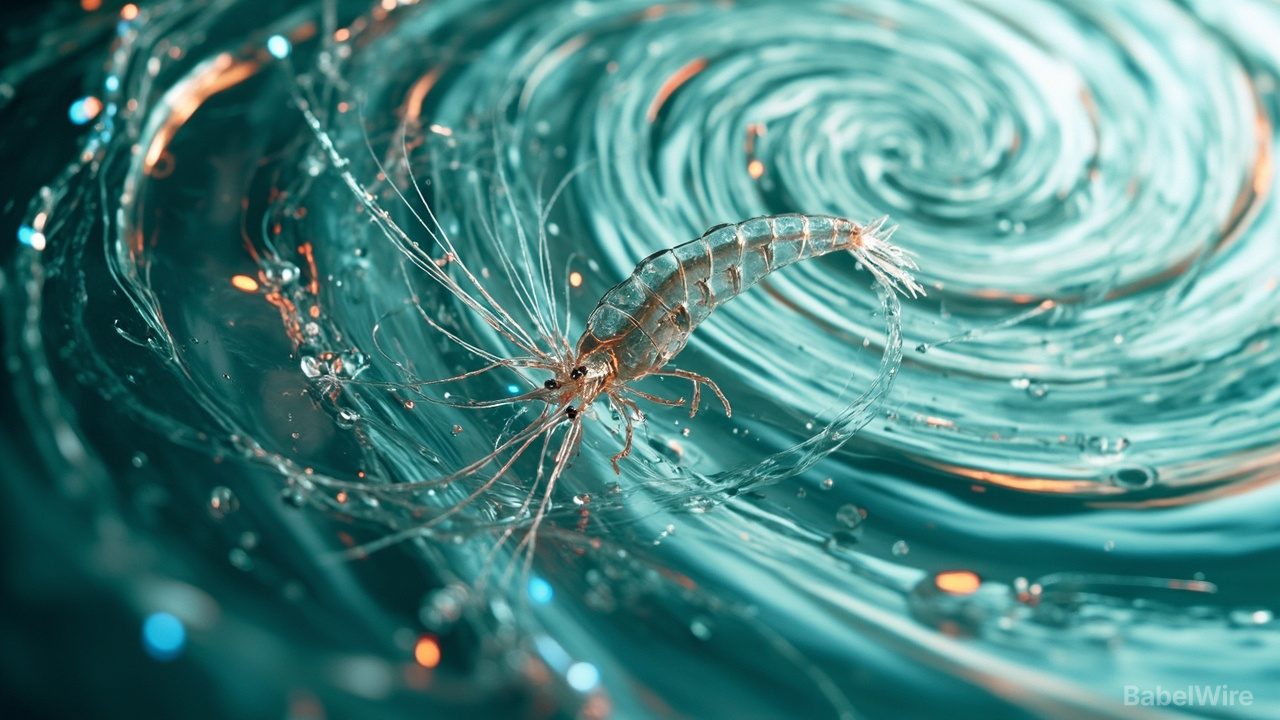
The discovery grew out of a study of brine shrimp — the "sea monkeys" of comic-book-ad fame — which swim upside down in salty water, beating their legs and trailing elongated abdomens like tails. Xinyu Si, then a student in engineer Lei Fang's lab, was investigating how living "active matter" mixes fluids. The lab studies swimmers that inject energy into their surroundings; the hypothesis was that turbulence generated by countless minuscule organisms plays an underappreciated role in churning the world's waterways.
Working in a two-dimensional turbulent system, Si and Fang placed a small obstacle in the flow and varied how it was angled. Disrupting the flow with the obstacle — tilted just so — changed the direction of the energy cascade.
"The geometry matters," Fang said.
The work, reported by Quanta Magazine, exploits a mathematical description of how forces push energy through a system. Gregory Falkovich, a physicist at the Weizmann Institute of Science and a pioneer in the study of two-dimensional turbulence, called it "a beautiful and skillful experimental work."
The implications reach beyond brine shrimp. Two-dimensional turbulence governs thin films, stratified atmospheric layers and plasmas; the researchers suggest applications in areas such as pollution control and drug design, and the effect may extend to larger, more chaotic three-dimensional flows.