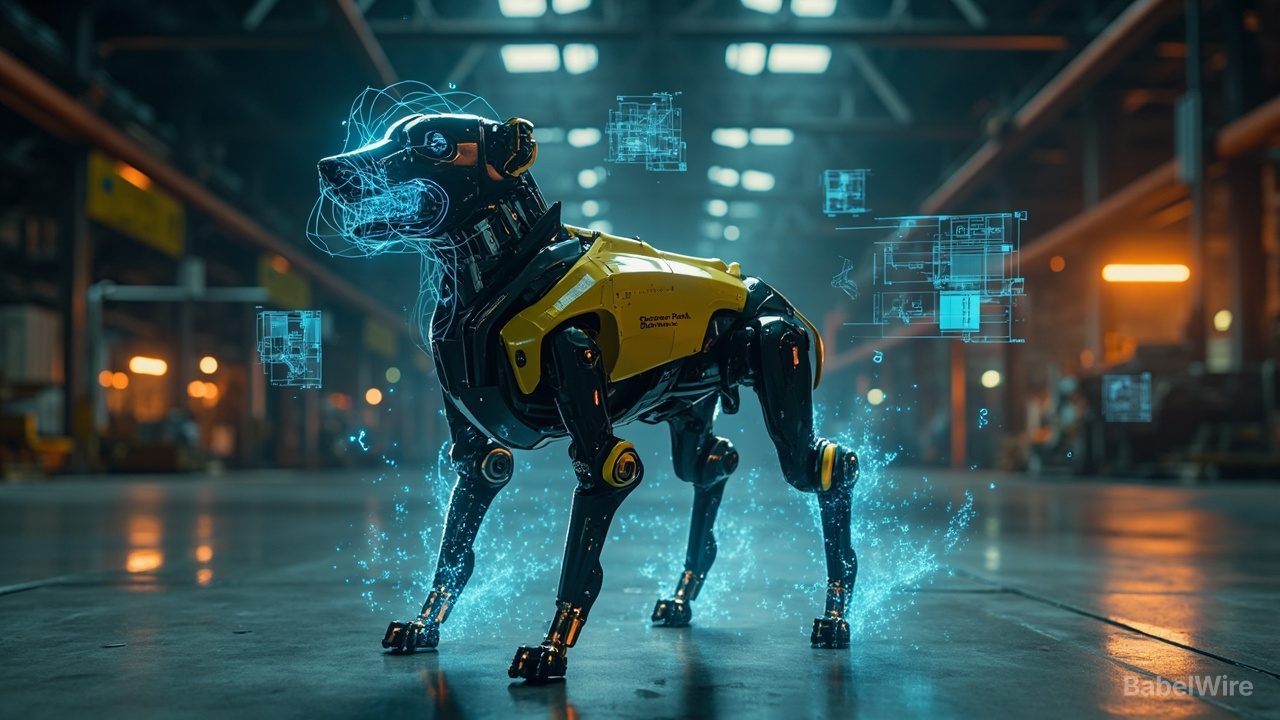
Boston Dynamics has partnered with Google Cloud and DeepMind to integrate Gemini Robotics-ER 1.6 into its Spot robot and Orbit inspection platform, giving the iconic quadruped something it has never had before: a general-purpose AI brain capable of spatial reasoning, autonomous decision-making, and continuous learning in complex industrial environments.
The integration marks a turning point for both robotics and AI. Spot, the famous yellow-and-black robot dog that has been deployed everywhere from oil rigs to disaster zones, has historically relied on narrowly scripted routines or remote teleoperation. With Gemini Robotics-ER — short for Embodied Reasoning — Spot gains the ability to understand physical space, plan movement, and make decisions without a human driving it frame by frame.
"The hardware got good years ago," the industry has often noted. "The intelligence to make robots genuinely useful in messy real-world environments is only arriving now."
Gemini Robotics-ER is specifically designed for embodied reasoning — understanding three-dimensional space, predicting physical interactions, and adapting to unstructured environments. Bolting it onto best-in-class hardware like Spot produces a machine that can inspect a facility, identify anomalies, and determine a response autonomously.
The partnership connects two parallel trends that defined 2026: frontier AI models growing beyond text and images into physical-world reasoning, and robotics hardware reaching a stage where the limiting factor is intelligence, not mechanics.
The honest caveat is the one that shadows all embodied AI. Navigation and reasoning are being solved separately, and stitching them into a production robot reliable enough for a night shift in a chemical plant remains unproven at scale. But Spot getting a Gemini brain is a genuine milestone — the clearest sign yet that the robotics and frontier-model races are merging into a single industry.