The Black Hole Information Paradox
For nearly 50 years, the black hole information paradox has been one of the most stubborn problems in theoretical physics. Stephen Hawking's 1974 discovery that black holes emit radiation and slowly evaporate created a devastating conflict: if a black hole evaporates completely, all information about what fell in is lost forever — violating a fundamental principle of quantum mechanics that information can never be destroyed.
Now, researchers have proposed a compelling resolution. A new study published in late June 2026 suggests that black holes stop evaporating at the very last moment, leaving behind tiny stable remnants that preserve all the information they contained.
Tiny Remnants, Immense Implications
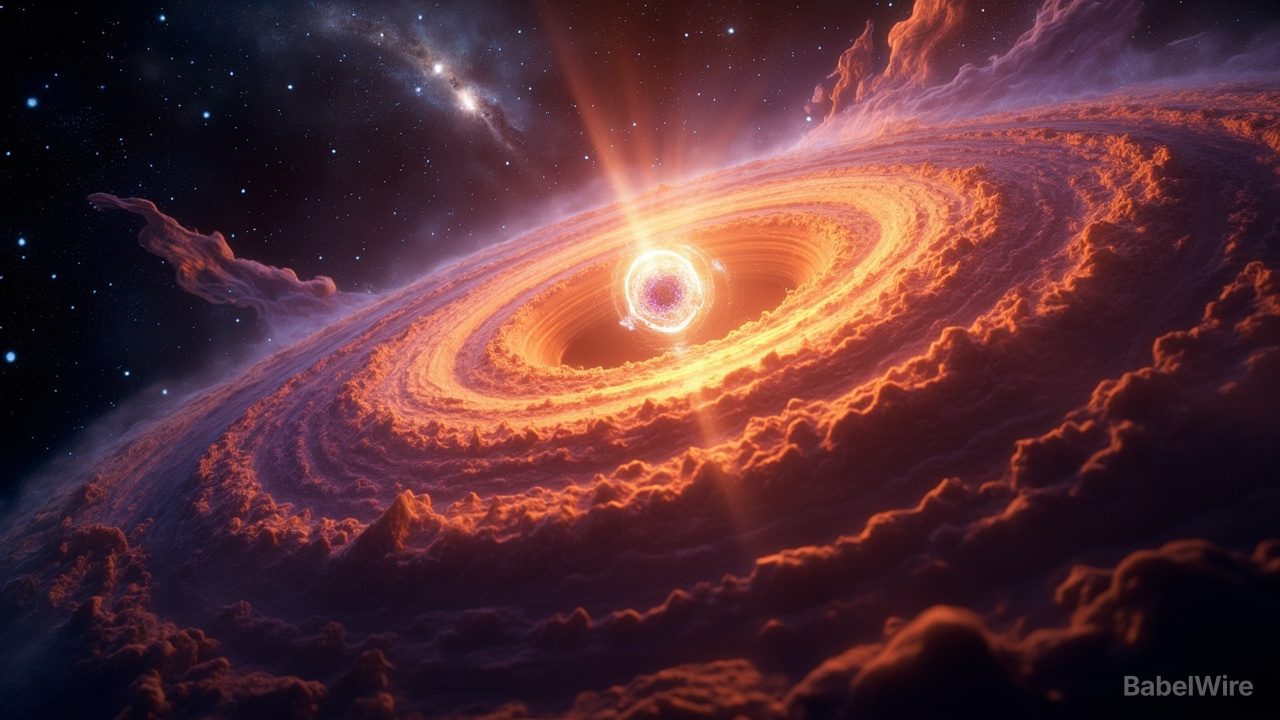
These remnants would be extraordinarily small — far smaller than an atom — but incredibly dense, carrying the complete information record of everything that ever crossed the event horizon. The proposal draws on a seven-dimensional geometric framework that elegantly resolves the contradiction between general relativity and quantum mechanics at the heart of the paradox.
'The same seven-dimensional geometry that explains how black hole remnants preserve information may also explain why elementary particles have the specific masses we observe,' the researchers noted. This potential connection between black hole physics and particle physics — two fields that rarely intersect — makes the theory especially compelling to physicists.
The Seven-Dimensional Framework
The theory extends our familiar four-dimensional spacetime (three spatial dimensions plus time) into a higher-dimensional space. In this framework, a black hole doesn't evaporate to nothing — it reaches a minimum size where quantum gravitational effects stabilize it, creating a remnant. These remnants would be effectively stable, lasting far longer than the current age of the universe.
Why This Matters
If confirmed, the theory would resolve the most significant conflict between Einstein's general relativity and quantum mechanics. It would also mean that black holes are not cosmic shredders but rather the universe's most secure data storage devices — preserving information indefinitely in a form we cannot yet read.
'This isn't just an abstract theoretical exercise,' the lead researcher explained. 'The information paradox has been the central obstacle to a unified theory of physics for decades. A resolution opens the door to deeper questions about the nature of spacetime, quantum gravity, and the ultimate fate of information in the universe.'
Experimental verification remains challenging: detecting black hole remnants would require observing the final moments of black hole evaporation, which is far beyond current telescopic capabilities. However, the mathematical consistency of the seven-dimensional framework provides a theoretical foundation that researchers can build upon.