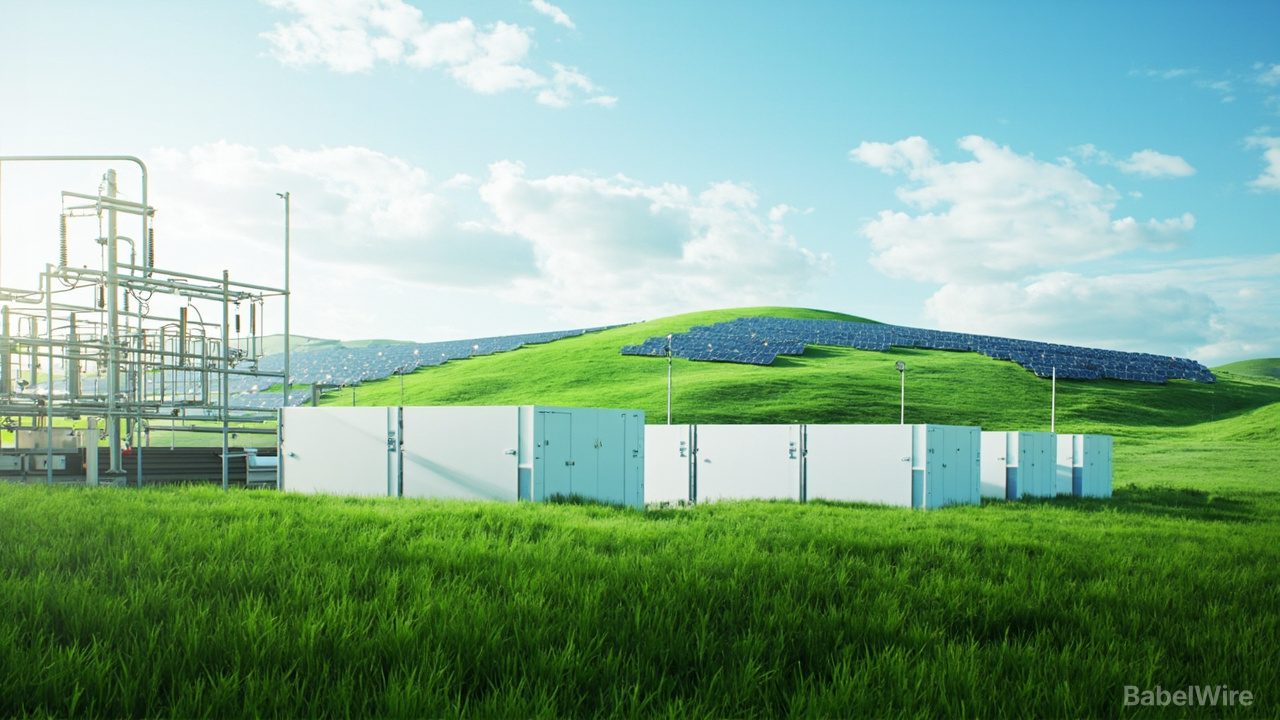
A new study by the Fraunhofer Institute for Energy Economics and Energy System Technology (IEE), commissioned by the German Solar Industry Association (BSW-Solar), concludes that strategically deployed batteries at rural substations could dramatically expand Germany's capacity to absorb solar power.
The study finds that at 1,313 rural, renewable-heavy substations across Germany, intelligent battery storage systems could allow the grid to host up to 150 GW of additional photovoltaic capacity — exceeding the country's entire installed PV base of approximately 130 GW.
The central insight is that transformer capacity is not a fixed ceiling. Transformers reach their limits only at specific times; the rest of the year, significant headroom goes unused. By absorbing peak solar output during high-production hours and feeding it back into the grid later, battery systems smooth the intermittency problem that currently constrains solar expansion.
The Fraunhofer researchers analyzed real operational data from 20 transformers across 13 substations, then extrapolated to the 1,313 substations using similarity analysis. At each substation, more than double the renewable energy capacity a transformer can nominally transmit could be connected, with only about 1% of the additional solar generation needing to be curtailed annually due to transformer limits.
BSW-Solar argues that the current energy legislation under debate in the Bundestag — the so-called Netzpak — needs to account for this potential. The association warns that existing plans risk declaring large portions of Germany as grid congestion zones, which would effectively block further renewable expansion through a proposed Redispatch reserve.
The researchers stress that batteries alone are insufficient — the critical element is intelligent control that responds to actual power flows at each substation, absorbing energy precisely when local feed-in peaks would push the transformer to its limit.