Bambu Lab officially unveiled its new flagship on Tuesday after alleged leaks, a short teaser and several rounds of filings with the US FCC. The H3C starts at 2,500 euros.
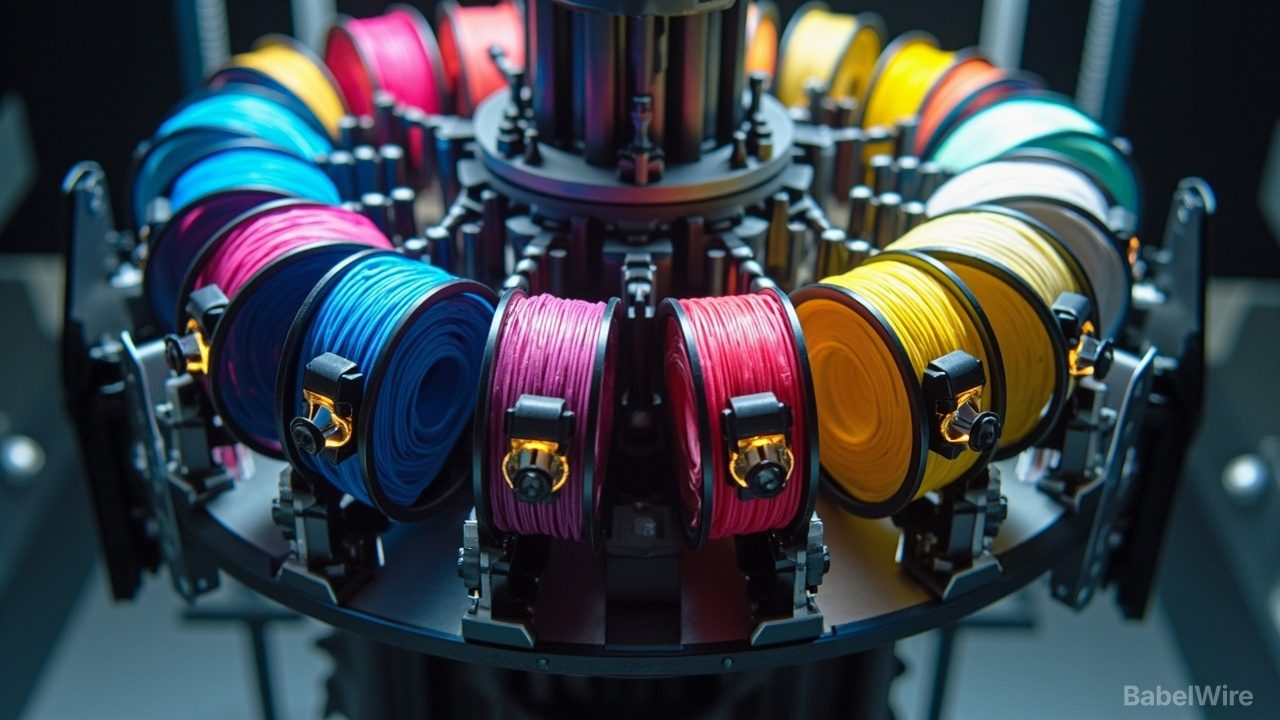
The core of the machine is nine toolheads — PrintTools, in Bambu's vocabulary — each with its own filament feed and its own heating system. Unlike changer systems that fetch a hotend out of a magazine, the filament stays loaded, pre-heated and ready, and a material change takes six seconds by the company's count. Bambu calls the mechanism Swaptek. The previous flagship, the H2C, stays on sale and works with up to six swappable hotends plus one fixed one, for seven materials; the H3C gets nine. Multi-toolhead printers already exist from Prusa (XL/XL+) and Snapmaker (U1), but four to six toolheads has been the norm.
It is paired with a new material system, the AMS 3H, which holds nine spools. Active drying now reaches 85 degrees Celsius instead of 65, though only for two spools at a time. Bambu says the AMS 3H can be combined with other AMS units, taking the machine to 24 colours; with CMYKW five-colour mixing, the pitch is that almost any colour can be produced without buying a whole spool for one detail. The AMS 3H is also the first in the line with its own power supply — up to 200 watts at 220 volts, 70 watts in steady state, per the spec sheet.
A second focus is TPU, the rubbery filament that behaves, in the usual analogy, like pushing a wet noodle through the extruder. The H3C ships with eight 0.4 mm toolheads for everyday multi-material and full-colour work plus one 2.85 mm head; a new FlexFeed extruder handles both 1.75 mm and 2.85 mm filament and is claimed to print soft 75A TPU up to five times faster than before. Build volume grows marginally to 330 × 320 × 325 mm from the H2C's 325 × 320 × 320 mm. An optional air purifier, the E1, pairs with the printer and starts filtering automatically when a job begins.
Bambu is also careful to say Swaptek is not limited to 3D printing: cutting, drawing and embossing tools are meant to mount and swap the same way. That is the real claim being staked here — that the tool change itself, not the motion system, is the product now.