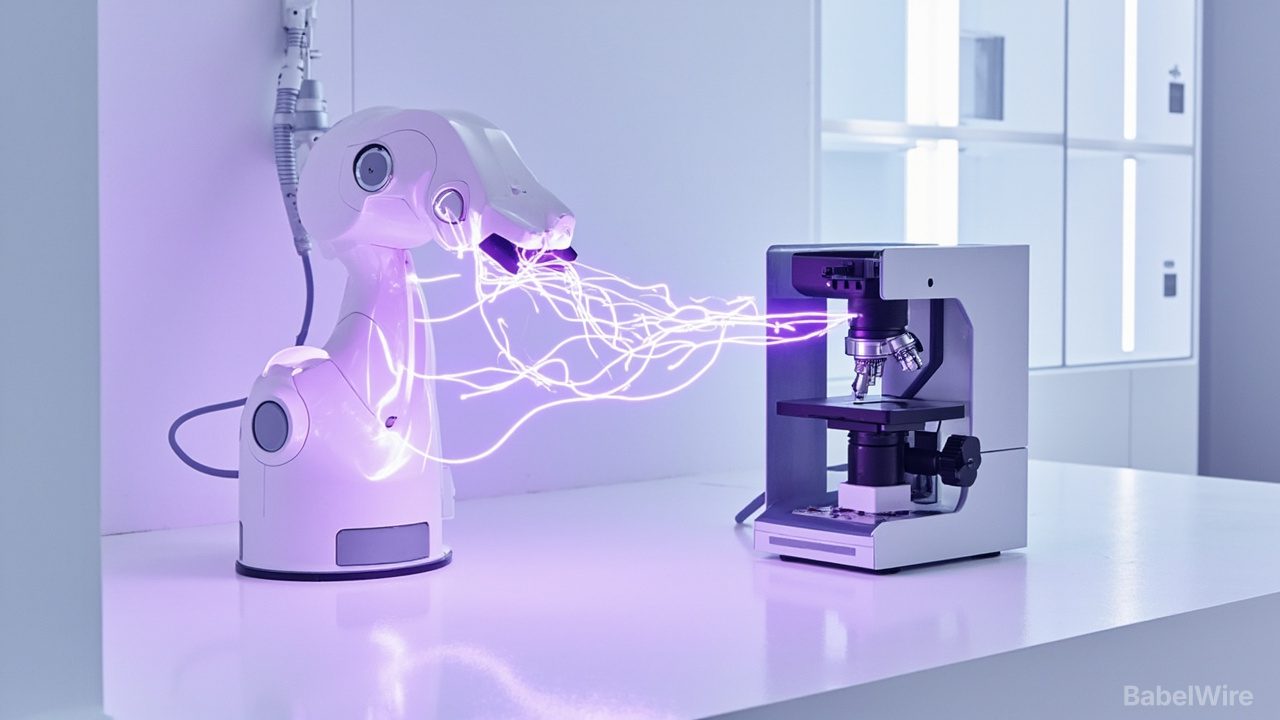
From Chatbots to Robot Arms
Anthropic on August 27 released a research preview of the "Model Hardware Standard" (MHS), a framework that bridges the gap between AI agents and physical devices. Unlike Anthropic's core business of language models and chatbots, MHS is designed to let Claude-powered agents operate scientific instruments and manufacturing hardware — microscopes, robotic arms, quantum computer calibration systems, and other programmable equipment.
The standard enables multiple agents to control multiple instruments in tandem, performing complex multi-step tasks that currently require constant human oversight. Anthropic's examples range from routine drug discovery experiments to laser calibration on a quantum computer — workflows where precision and repeatability matter more than creativity.
How It Works
MHS works on any device that has a programmable interface. The standard provides a communication layer that allows devices and agents to talk to each other across networks, regardless of the underlying hardware or protocol. This is deliberately vendor-agnostic: the goal is to create a universal interface that any AI agent can use to control any compatible device.
The key insight is that AI agents have gotten good enough at reasoning and planning that the bottleneck is no longer intelligence — it's the physical connection to the world. MHS solves this by standardizing the interface between agents and hardware, much like how HTTP standardized communication between web servers and browsers.
Safety First, Open Source Later
Anthropic is taking a cautious rollout. The company is sharing an early version of MHS with select partners to help build out safety evaluations before making the framework open source. This phased approach reflects the genuine risks of autonomous agents controlling physical equipment — a misaligned agent operating a laser or chemical dispenser could cause real damage.
The safety evaluation phase will focus on ensuring agents maintain appropriate guardrails when operating hardware: confirming that actions are intentional, that human operators can intervene at any point, and that the system fails safely when something unexpected occurs.
What It Means
MHS represents a meaningful step toward the vision of autonomous laboratories and "lights-out" manufacturing, where AI systems can run experiments and production processes around the clock with minimal human intervention. If the framework gains adoption, it could accelerate research timelines in drug discovery, materials science, and semiconductor manufacturing.
For Anthropic, MHS also represents a strategic expansion beyond pure software. By becoming the standard through which AI agents interact with the physical world, Anthropic positions itself at a critical chokepoint in the emerging agentic economy.