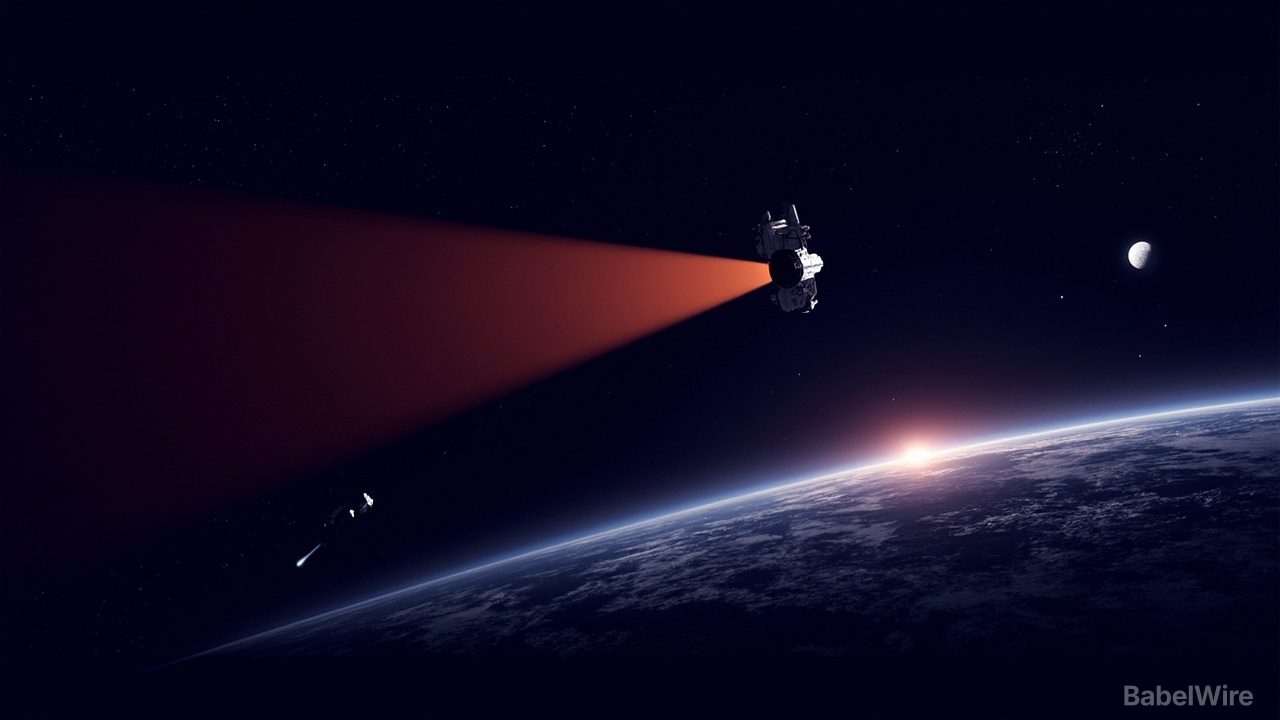
Anduril Industries said Tuesday that its first satellite on orbit, Anduril-216, has demonstrated a long-wave infrared sensor able to track other spacecraft even when they pass through Earth's shadow — a gap that has long limited space-domain awareness.
The oven-sized satellite launched in July on a SpaceX rideshare mission and flies about 590 km up, spending roughly a third of each orbit in darkness. Its sensor images in long-wave infrared, detecting heat signatures rather than reflected sunlight. "What's unique about that is it's got a huge dynamic range," said Gokul Subramanian, Anduril's senior vice president of engineering. "It has very low solar exclusion, so we're blocked by the Sun very rarely, and we can see things in full dark."
The Space Force tracks satellites both to warn of threatening maneuvers and to issue collision alerts. Optical tracking has an eclipse gap, and the US has no ground sensors on adversaries' territory. "With the long-wave infrared space sensor, we're looking to close that gap," said Adam Thurn, Anduril's vice president and general manager of orbital systems.
Anduril released one image from the demo: an infrared view of the Moon above Earth's horizon. The company said the sensor can do both unresolved and resolved imagery, suggesting it could inspect other satellites at close range, and that the satellite's edge-compute module fuses sensor data into tracking solutions on orbit without ground analysis.
The spacecraft platform was built by startup Apex Space; Anduril has no plans to open its own satellite production line, preferring to buy third-party buses and integrate its own sensors and compute. At present it plans to sell space-domain-awareness data to the US military rather than the hardware — though that "could change in the future."