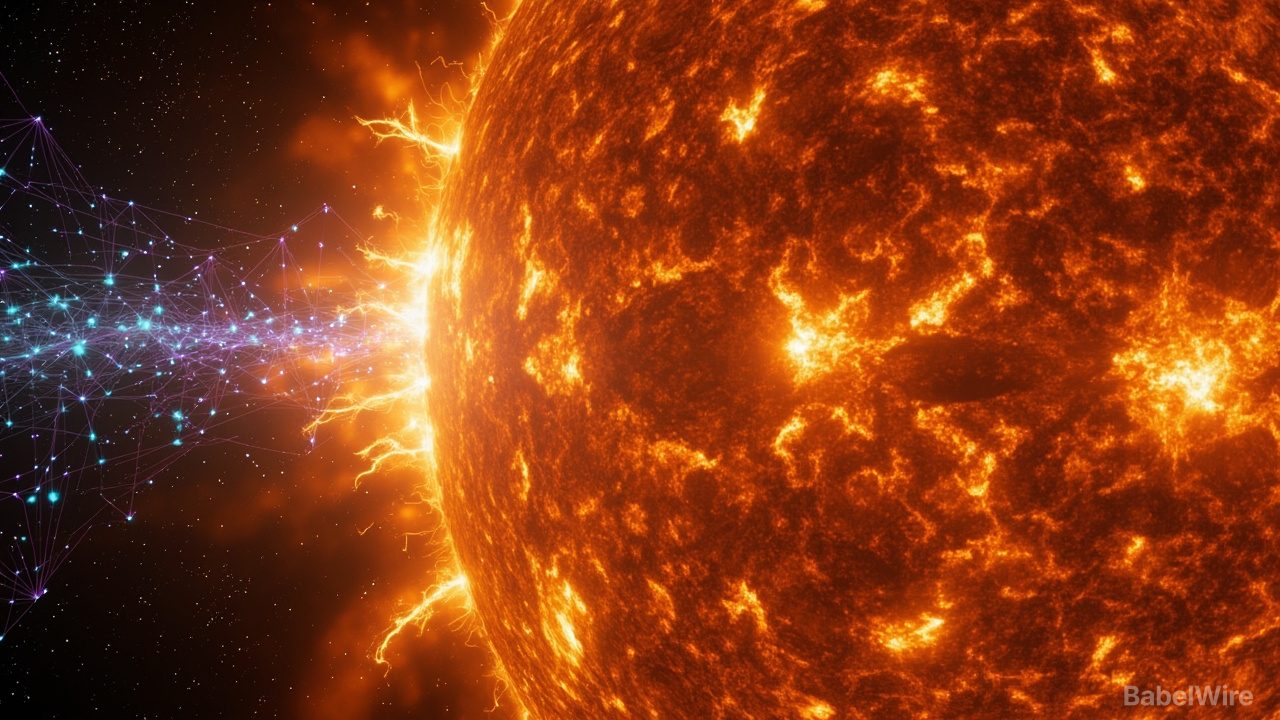
Before a sunspot darkens the visible surface of the Sun, the magnetic activity that creates it is already developing out of sight. A new AI system called EarlyDetect can now spot those faint precursor signals nearly nine hours before the active region becomes visible — a potential game-changer for space weather preparedness.
The model was developed by a New Jersey Institute of Technology-led team and described in the Journal of Geophysical Research: Machine Learning and Computation. Built on a Transformer architecture — the same class of AI behind ChatGPT — EarlyDetect analyzes hourly maps of acoustic power together with magnetic field measurements from NASA's Solar Dynamics Observatory.
The key insight came from an unexpected finding: when the team initially applied noise-filtering to clean up the solar data, the model's predictions got worse, not better. The "noise" they tried to remove actually contained the faintest, earliest warning signals. "The signals that the filter removed turned out to be really important in helping the model predict when an active region would emerge," said Jonas Tirona, the undergraduate researcher who led the model's development.
After training on known emergence events, EarlyDetect detected precursor patterns an average of 9.24 hours before active regions appeared on the Sun's surface. The team also released the Solar Active Region Emergence Dataset (SolARED), the first public dataset of its kind, to help other researchers develop prediction models.
However, EarlyDetect is not yet operational. It can still produce false alarms, and detecting an active region's emergence does not mean a solar flare or coronal mass ejection will follow — many active regions never produce major eruptions. The researchers plan to test the model against a much larger set of solar events before any operational deployment.
Sources
- scitechdaily.comSciTechDaily: New AI Detects Hidden Warning Signs of Solar Eruptions Hours Before They Emerge
- phys.orgPhys.org: New AI model detects hidden signs of solar eruptions hours before they emerge
- doi.orgJournal of Geophysical Research: Forecasting Continuum Intensity for Solar Active Region Emergence Prediction Using Transformers