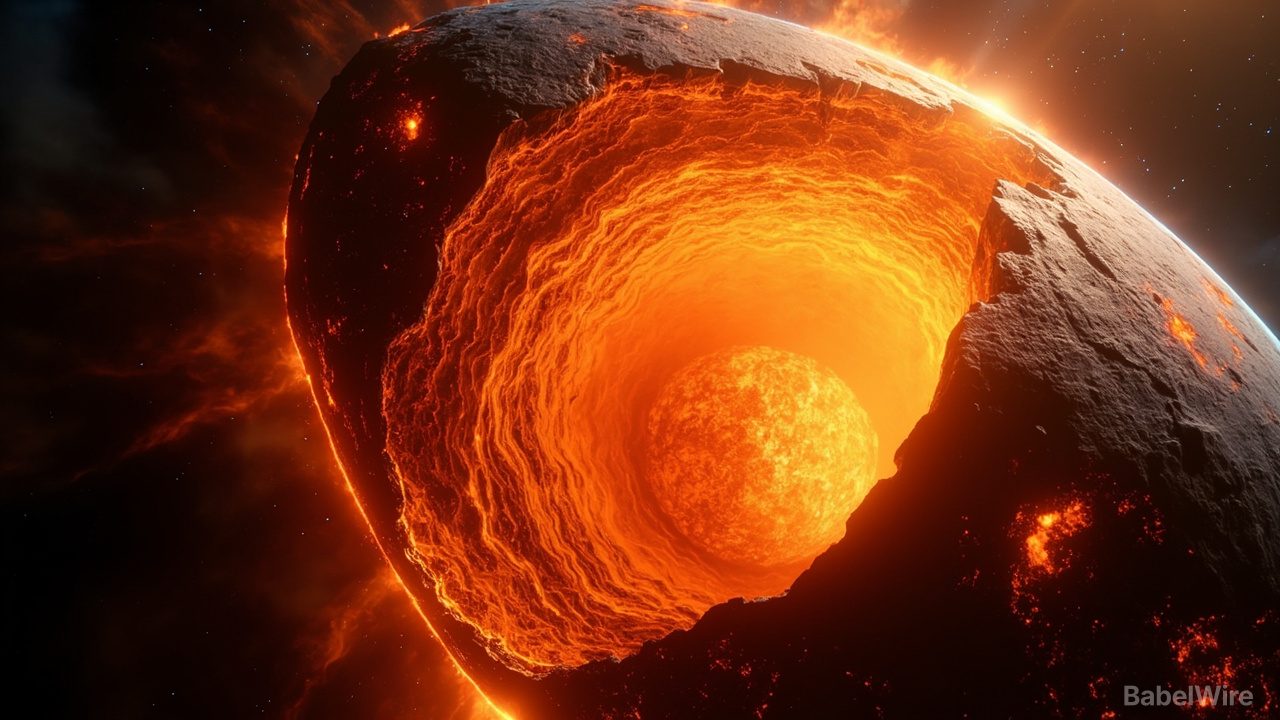
A vast plume of superheated rock rising from near Earth's core-mantle boundary may be the hidden force pulling East Africa apart, according to a new study that combines over 12 years of GPS measurements with advanced 3D thermomechanical models.
The East African Rift System is the largest continental rift on Earth -- a place where the African plate is slowly splitting into two. Geophysicists had long observed that deformation in the region didn't match simple predictions: in addition to the expected sideways stretching perpendicular to the rift, the land was also moving northward, parallel to it. That anomalous motion was a mystery.
The answer, researchers found, lies with the African Superplume -- an enormous zone of rising mantle material that begins deep beneath southwest Africa and extends northeastward across the continent. As the plume travels north, it becomes progressively shallower, creating northward mantle flow that drags the overlying plate with it.
Using 3D computational simulations, first author Tahiry Rajaonarison and geophysicist D. Sarah Stamps at Virginia Tech showed that this deep mantle flow can account for the parallel deformation and also explains a matching pattern in seismic wave behavior beneath the rift -- a phenomenon called seismic anisotropy.
The findings add new evidence to a long-running debate about what drives continental rifting. Scientists have generally focused on two forces: shallower lithospheric buoyancy, driven by differences in elevation and density, and deeper mantle traction, driven by flowing rock deep below the surface.
Previous studies showed that buoyancy forces explain the familiar perpendicular stretching but not the parallel movement. The new research demonstrates that the African Superplume's mantle flow is responsible for the latter.
The result is a more complex picture: no single force is responsible for everything happening in the East African Rift. Shallow buoyancy drives the typical stretching, while deep mantle flow from the superplume adds the unusual northward pull. Understanding how these forces interact matters because the rift provides a natural laboratory for studying how continents begin to break apart -- a process that ultimately creates new oceans.
Sources
- sciencedaily.comA massive plume deep beneath Africa is pulling the continent apart -- ScienceDaily
- futura-sciences.comA giant crack is spreading across Africa -- scientists think they have finally found what is driving it -- Futura Sciences
- eurekalert.orgScientists detect deep Earth pulses beneath Africa -- EurekAlert