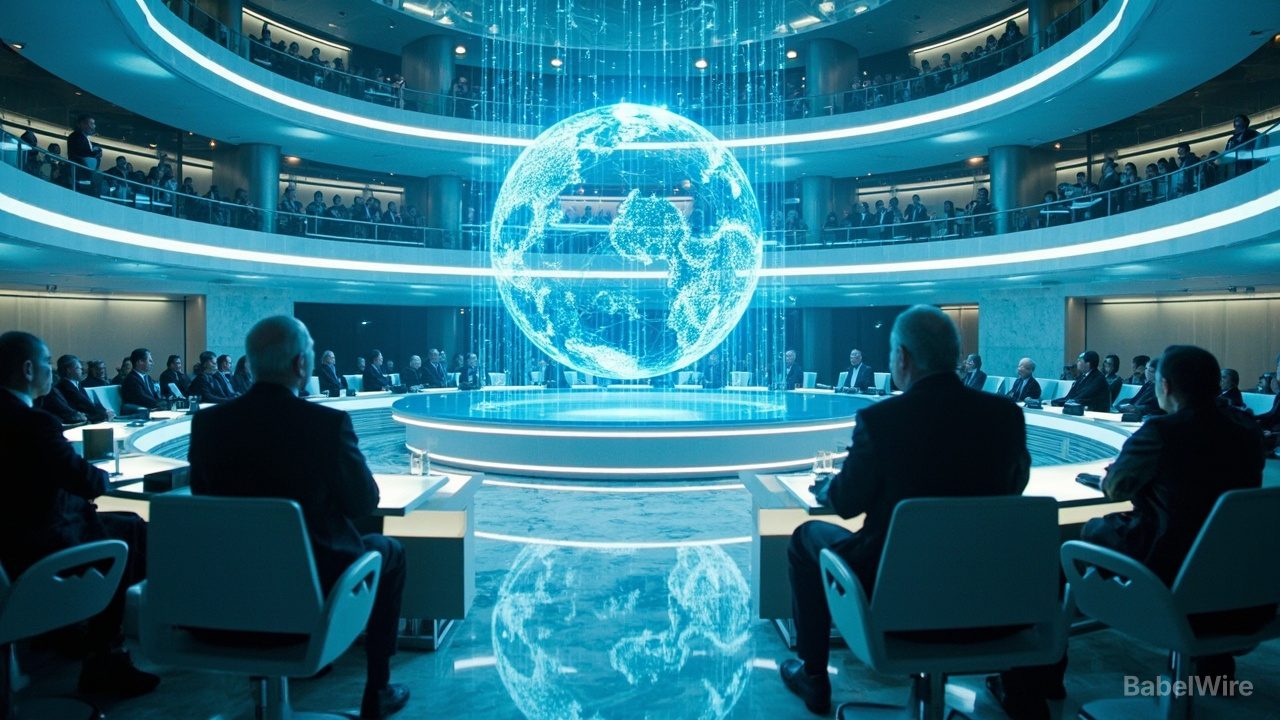
A Historic Assembly
On July 1, 2026, the United Nations and its International Telecommunication Union (ITU) announced the launch of the AI for Good Global Commission — the first-ever UN-level body to include the CEOs and presidents of the companies building the world's most powerful AI systems. The Commission brings together 44 Founding Members from government, industry, and international institutions.
Salesforce CEO Marc Benioff and Rwandan President Paul Kagame serve as co-chairs. ITU Secretary-General Doreen Bogdan-Martin is Vice-Chair. The technical leadership reads like a who's who of AI: Nvidia founder and CEO Jensen Huang, Amazon CEO Andy Jassy, Anthropic co-founder Jack Clark, Cohere co-founder Aidan Gomez, Microsoft President Brad Smith, and Google's James Manyika, among others.
Heads of state including Estonian President Alar Karis, Icelandic President Halla Tómasdóttir, and ministers from Kazakhstan, Namibia, Nigeria, Singapore, and Togo are also founding members. The private sector is represented by leaders from Accenture, Pfizer, Qualcomm, Reliance, Roche, Vodafone, ZTE, and more.
Geneva: The World's AI Governance Capital
The Commission's inaugural meeting will be held on July 8 in Geneva, coinciding with the first UN Global Dialogue on AI Governance (July 6–7) and the ITU AI for Good Global Summit (July 7–10). Together, these events bring over 11,000 participants from 169 countries to the Palexpo convention center — making Geneva the epicenter of global AI governance for one unprecedented week.
Key figures attending include AI pioneer Yoshua Bengio, futurist Ray Kurzweil, and philosopher Stuart Russell, alongside government delegates from across the world. The summit features a 20,000 square meter expo with over 200 technology demonstrations spanning humanoid robots, brain-computer interfaces, and quantum systems.
The Agenda
The Commission's stated mission has three pillars: advancing responsible AI solutions, bridging the AI access gap for the 2.2 billion people worldwide who lack reliable internet access, and building global consensus on AI standards that can transcend political divisions.
The broader Geneva Dialogue focuses on four policy areas: AI governance frameworks and international interoperability, AI for development in the Global South, energy demand from AI infrastructure and its climate implications, and cybersecurity in the age of autonomous AI agents.
Significance and Challenges
The Commission's launch comes at a pivotal moment. The Fable 5 crisis demonstrated that unilateral national decisions on AI export controls create global disruptions that developing nations bear as costs. The UN Scientific Panel on AI, co-chaired by Yoshua Bengio, published its first global assessment this week, finding that AI capabilities are outpacing scientific understanding and governance frameworks.
The challenges are immense. Nvidia's Jensen Huang sits on a commission whose debates will necessarily address Nvidia's global chip dominance — every national AI strategy depends on access to compute that Nvidia largely controls. The commission includes both democratic and autocratic governments, alongside companies whose commercial interests shape AI development.
"One thing is certain: technology is supposed to be a force for good, and we have a responsibility to use it accordingly," said President Kagame. Marc Benioff added: "AI is the most profound technological transition in history. And our values have to guide every step."